

API 610 vs ANSI/ISO 5199 Pump Standards: Which One Does Your Plant Need?
API 610 vs ANSI/ISO 5199 Pump Standards are among the most widely specified engineering standards for centrifugal process pumps, and selecting the right one is one of the most important decisions in industrial pump procurement. Specifying the wrong pump standard is one of the most expensive mistakes a procurement team can make—not because the pump fails immediately, but because it becomes a maintenance burden for the next fifteen years. Choosing between API 610 vs ANSI pump standard options is not simply a formality on a purchase order; it is a critical engineering decision that determines how a pump will be built, how long it will operate between overhauls, and how much it will cost to maintain throughout its service life.
Both API 610 and ANSI B73.1 (closely aligned with ISO 5199 for international chemical process pump applications) are proven, globally recognized standards for centrifugal pumps. Neither standard is universally “better” than the other—each was developed to address different operating philosophies and industry requirements. The challenge for engineers, consultants, EPC contractors, and procurement professionals is to match the appropriate standard to the actual process duty, equipment criticality, reliability expectations, and lifecycle objectives of the application, rather than defaulting to the standard that is most familiar or frequently specified in project documentation.
Procurement Risk: Specifying API 610 for a non-critical, low-hazard duty can mean paying significantly more than necessary. Specifying ANSI/ISO 5199 for a continuous, high-criticality hydrocarbon service can mean chronic reliability problems, unplanned shutdowns, and safety exposure. Both directions carry real cost.
This guide compares API 610 and ANSI/ISO 5199 pump standards in detail — design philosophy, construction, reliability expectations, cost, and industry preference — so you can make a defensible, engineering-based specification decision rather than an assumption-based one.
|
Chemical Processing
|
⛽
Petrochemical
|
Oil & Gas
|
Refineries
|
Power Plants
|
Fertilizer
|
💊
Pharmaceuticals
|
Water Treatment
|
SECTION 01
What Are Industrial Pump Standards?
Industrial pump standards are formal engineering specifications that define how a pump must be designed, constructed, tested, and documented for a given class of service. They exist because pumps built to inconsistent, ad-hoc designs create unpredictable safety, reliability, and maintenance outcomes across a plant.
A recognized standard serves several purposes at once:
- Safety: Defines minimum requirements for pressure containment, sealing, and materials suited to the hazard class of the fluid.
- Reliability: Sets mechanical design limits — shaft stiffness, bearing life, vibration limits — that directly influence mean time between failures.
- Interchangeability: Standardized dimensions allow different manufacturers’ pumps to be installed on the same baseplate footprint, simplifying replacement and spares strategy.
- Maintenance planning: A known standard means known spare parts, known overhaul intervals, and known documentation requirements.
Pump standards apply at every stage of the equipment lifecycle — from the initial engineering specification and vendor selection, through design review and factory testing, to installation, commissioning, and the maintenance and overhaul strategy that follows for the next 15 to 25 years. Selecting the correct standard early in a project has more influence on long-term reliability than almost any other single procurement decision.
SECTION 02
What Is API 610?
API 610 (formally, “Centrifugal Pumps for Petroleum, Petrochemical, and Natural Gas Industries”) is a specification developed by the American Petroleum Institute for heavy-duty centrifugal pumps used in demanding hydrocarbon and process services. It is now published jointly with ISO 13709, making it the internationally recognized standard for critical process pump service.
API 610 was developed specifically for refineries and petrochemical facilities, where pump failure can mean a fire, a toxic release, or an extended unplanned shutdown costing far more than the pump itself. Its design philosophy reflects that risk profile: build the pump to run for years without unplanned intervention, even under continuous, high-temperature, high-pressure duty.
Design Philosophy
API 610 pumps are engineered for maximum reliability and long mean time between planned maintenance (MTBPM), rather than minimum purchase cost. This shows up in heavier casings, larger shafts, more robust bearing housings, and generous design margins on every wetted and rotating component.
Key Design Characteristics
- Thick-walled casings designed for high pressure and nozzle loading, per API 610 Annex F allowable forces and moments
- Oversized shafts for low deflection at the seal faces, improving mechanical seal life
- Heavy-duty bearing housings, often with oil mist or pressurized lubrication systems
- Back pull-out design in most configurations, allowing maintenance without disturbing piping
- Baseplates designed for rigidity and precise alignment retention over years of operation
- Stringent mandatory hydrostatic, performance, and mechanical running testing
Advantages
- Exceptional reliability and long service intervals under continuous, critical duty
- Robust design margins that tolerate upset conditions without catastrophic failure
- Comprehensive factory testing and documentation reduces commissioning risk
Limitations
- Significantly higher purchase cost than ANSI or ISO 5199 equivalents
- Larger footprint and heavier installation, increasing civil and structural costs
- Frequently over-specified for services that do not require this level of robustness
SECTION 03
What Is ANSI B73.1 / ISO 5199?
ANSI B73.1 is a dimensional standard published by ASME for horizontal end suction chemical process pumps used widely across the United States. ISO 5199 is its internationally recognized counterpart, used predominantly in Europe, the Middle East, and Asia, covering a similar class of process pump with broadly comparable design intent. Both standards define standardized mounting dimensions rather than the more prescriptive mechanical design margins found in API 610.
ANSI B73.1 and ISO 5199 pumps are built for general and moderately demanding chemical process duty — not for the continuous, high-hazard hydrocarbon service that API 610 targets. Their defining feature is dimensional interchangeability: a pump built to these standards by one manufacturer can typically be replaced with an equivalent pump from another manufacturer without changing the baseplate or piping.

- Standardized envelope dimensions across manufacturers, simplifying spares and replacement
- Back pull-out design for maintenance access without piping disturbance
- Wide range of material options, including lined and non-metallic construction for corrosive service
- Lower design margins than API 610, sized for moderate duty rather than continuous severe service
Advantages
- Lower purchase cost and shorter lead times than API 610 equivalents
- Broad manufacturer availability and standardized spares
- Well suited to the majority of general chemical process duties
Limitations
- Lower reliability margins under continuous, high-temperature, or high-pressure hydrocarbon duty
- Shorter typical mean time between failures in severe or critical services
- Not intended for the hazard classifications API 610 was designed to address
SECTION 04
API 610 vs ANSI/ISO 5199 Pump Standards
The table below compares both standards across the factors that matter most to procurement and reliability decisions.
| Parameter | API 610 | ANSI B73.1 / ISO 5199 |
|---|---|---|
| Design Philosophy | Maximum reliability, long MTBPM | Dimensional standardization, moderate duty |
| Operating Duty | Continuous, severe, critical hydrocarbon service | General to moderate chemical process duty |
| Reliability | Very high, engineered for years of unplanned-intervention-free operation | Good for intended duty; lower margin under severe conditions |
| Shaft Stiffness | High — low L3/D4 ratio, minimal deflection | Moderate — adequate for standard duty |
| Bearing Design | Heavy-duty, often oil mist or pressure-lubricated | Grease or oil bath lubrication, standard duty rating |
| Mechanical Seals | API 682-compliant, engineered seal chambers | Standard seal chambers, wide seal options |
| Materials | Wide range including exotic alloys for severe service | Wide range including lined and non-metallic options |
| Pressure Rating | High — suited to demanding pressure duty | Moderate — suited to general process pressure |
| Temperature Capability | High-temperature hydrocarbon service standard | Moderate temperature range, application-dependent |
| Maintenance | Longer intervals, more involved overhaul procedures | Simpler maintenance, shorter typical intervals |
| Interchangeability | Standardized within API 610, fewer manufacturers | High — broad cross-manufacturer interchangeability |
| Purchase Cost | Significantly higher | Lower |
| Lifecycle Cost | Lower for critical duty due to reduced failures and downtime | Lower for non-critical duty within design intent |
| Typical Applications | Refinery, petrochemical, offshore, LNG, hydrocarbon processing | Chemical processing, fertilizer, water treatment, pharma |
| Industry Preference | Oil & gas, refining, power generation | Chemical, specialty chemical, general process industries |
SECTION 05
Key Design Differences
Beyond the specification-level comparison, the physical construction differences between API 610 and ANSI/ISO 5199 pumps explain why their reliability and cost profiles diverge so significantly.
Bearing Housing
API 610 bearing housings are built for extended life under continuous duty, frequently incorporating oil mist lubrication, constant-level oilers, or pressurized lubrication systems. ANSI/ISO 5199 pumps typically use simpler grease-packed or oil bath bearing arrangements adequate for standard duty cycles.
Shaft Deflection
API 610 mandates strict limits on shaft deflection at the seal faces (governed by the L3/D4 ratio), directly extending mechanical seal life. ANSI/ISO 5199 shafts are adequate for their intended duty but generally permit greater deflection under equivalent loads.
Impeller Design
Both standards use closed or semi-open impellers depending on service, but API 610 impellers are typically dynamically balanced to tighter tolerances given the higher operating speeds and criticality of hydrocarbon service.
Baseplate Construction
API 610 requires rigid, often fabricated steel or cast baseplates designed to maintain alignment over years without grouting failure. ANSI/ISO 5199 baseplates are typically lighter fabricated steel structures suited to standard installation practices.
Seal Chamber
API 610 seal chambers are engineered per API 682 to support advanced flush plans and larger, more robust mechanical seals. ANSI/ISO 5199 seal chambers are generally smaller, though still compatible with a wide range of standard mechanical seal designs.
Coupling Arrangement
API 610 typically specifies spacer-type couplings that allow seal and bearing maintenance without moving the driver, minimizing realignment work. ANSI/ISO 5199 pumps may use simpler coupling arrangements depending on the application.
Nozzle Loading
API 610 defines allowable piping nozzle loads (per Annex F) far more rigorously than ANSI/ISO 5199, reflecting the heavier, higher-temperature piping systems typical of refinery and petrochemical installations.
Casing Design and Mounting
API 610 casings are typically centerline-mounted to minimize thermal growth misalignment at high operating temperatures. ANSI/ISO 5199 pumps commonly use foot-mounted casings, adequate for the moderate temperature ranges they are designed for.
Rotor Dynamics
API 610 requires documented rotor dynamic analysis to confirm operation away from critical speeds across the full operating range. This level of analysis is not typically required for ANSI/ISO 5199 pumps, reflecting their lower speed and duty severity.
SECTION 06
Which Industries Prefer API 610?
API 610 is the default standard wherever hydrocarbon handling, high hazard classification, and continuous critical duty intersect.
| Industry | Why API 610 Fits |
|---|---|
| Refineries | Continuous hydrocarbon service at high temperature and pressure with severe consequences for failure |
| Petrochemical Plants | Aggressive, high-value process streams requiring long uninterrupted run times |
| Offshore Platforms | Limited maintenance access and high consequence of unplanned failure |
| LNG Terminals | Cryogenic and high-pressure hydrocarbon handling with strict safety requirements |
| Power Generation | Critical feedwater and process pumps where downtime directly affects plant output |
| Hydrocarbon Processing | Continuous, high-duty transfer of flammable or hazardous process fluids |
SECTION 07
Which Industries Use ANSI/ISO 5199 Pumps?
ANSI B73.1 and ISO 5199 pumps cover the large majority of general and moderately demanding chemical process applications where API 610’s design margins are not operationally necessary.
| Industry | Why ANSI/ISO 5199 Fits |
|---|---|
| Chemical Processing | Wide material options and standardized spares suit varied, moderate-duty process fluids |
| Fertilizer | Corrosion-resistant construction options at a cost point suited to plant economics |
| Pharmaceuticals | Hygienic, standardized designs for high-purity, moderate-pressure fluid transfer |
| Paint & Coatings | Standard duty transfer of solvents and viscous fluids at moderate pressure |
| Specialty Chemicals | Flexible material selection for varied, batch, or campaign-based production |
| Water Treatment | Reliable, cost-effective transfer of dosing chemicals and process water |
| Food Processing | Standard duty, hygienic-compatible construction at accessible cost |
SECTION 08
API 610 vs ANSI Pump Selection Guide
Use the following factors, evaluated together rather than in isolation, to determine which standard fits a given application.
- Fluid characteristics: Hazardous, flammable, or toxic hydrocarbons typically point toward API 610; general chemical fluids are usually well served by ANSI/ISO 5199.
- Pressure: High discharge pressure and demanding nozzle loading favor API 610’s heavier casing and piping load tolerance.
- Temperature: Continuous high-temperature hydrocarbon service favors API 610’s centerline mounting and thermal growth accommodation.
- Hazard level: Higher consequence-of-failure services (fire, toxic release, environmental impact) justify API 610’s additional design margin.
- Continuous duty: 24/7 critical-path pumps with no standby unit justify the reliability premium of API 610.
- Maintenance philosophy: Plants running a predictive, long-interval maintenance strategy align better with API 610; plants comfortable with more frequent, standardized maintenance can use ANSI/ISO 5199 effectively.
- Plant criticality: A pump with an installed spare and low failure consequence rarely needs API 610-level robustness.
- Budget: Capital budget constraints may favor ANSI/ISO 5199, provided the duty genuinely falls within its design envelope.
- Lifecycle cost: For critical, continuous duty, API 610’s higher purchase price is frequently offset by avoided downtime over the equipment’s life.
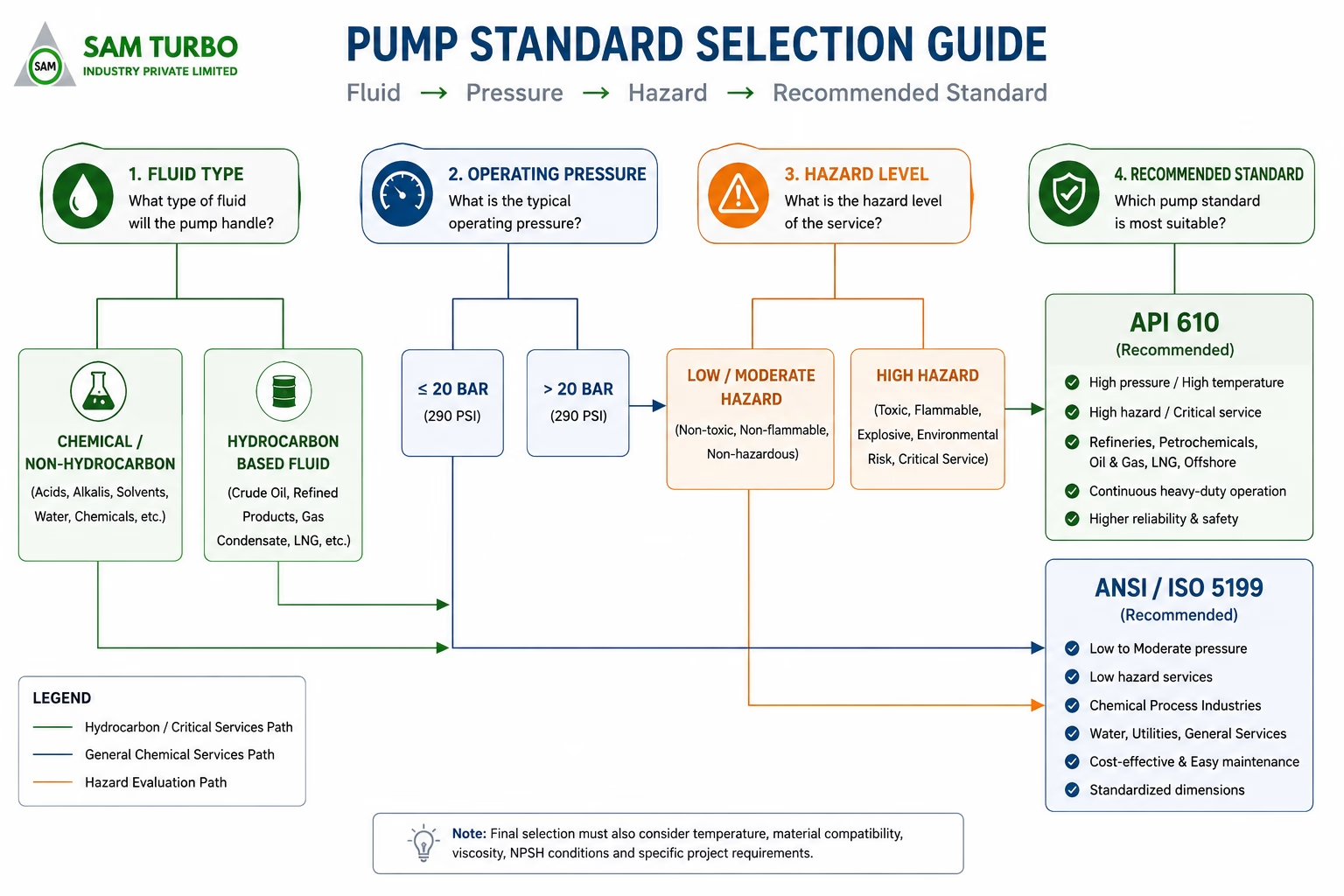
Decision-Making Checklist
- Has the fluid’s hazard classification and consequence of failure been assessed?
- Is the service continuous and critical, or is there an installed standby pump?
- Does the process operate at high temperature or pressure requiring heavier construction?
- Has the plant’s maintenance philosophy (long-interval predictive vs. standard scheduled) been considered?
- Has total lifecycle cost been compared, not just purchase price?
- Is dimensional interchangeability with existing installed pumps a requirement?
- Does the applicable project specification or client standard mandate API 610?
- Has the vendor’s testing and documentation capability been confirmed for the selected standard?
SECTION 09
Procurement Checklist
Once the standard has been selected, the following items should be confirmed before finalizing a pump purchase order.
| Checklist Item | What to Confirm |
|---|---|
| Process Conditions | Flow, head, temperature, pressure, and fluid properties fully documented |
| Applicable Standards | Correct standard confirmed against project specification and client requirements |
| Material Selection | Wetted materials verified against full fluid chemistry, not just fluid name |
| Mechanical Seals | Seal type and API 682 plan (where applicable) matched to hazard and emissions requirements |
| Driver Selection | Motor sizing, area classification, and coupling compatibility confirmed |
| Efficiency | Hydraulic efficiency at rated and normal operating points reviewed |
| Spare Parts | Recommended spares list and lead times confirmed with vendor |
| Vendor Capability | Manufacturing, testing, and after-sales support capability verified |
| Documentation | Datasheets, GA drawings, and QA/QC documentation package defined |
| Testing Requirements | Hydrostatic, performance, and mechanical running test requirements agreed in advance |
SECTION 10
Common Mistakes When Selecting Pump Standards
Most standard-selection problems trace back to a handful of recurring procurement and engineering mistakes.
| Mistake | Consequence | Correct Approach |
|---|---|---|
| Choosing based only on purchase price | Higher lifecycle cost from repeated failures | Evaluate total lifecycle cost, not just capex |
| Ignoring lifecycle cost | Underestimated maintenance and downtime expense | Model maintenance, spares, and downtime cost over 10–15 years |
| Wrong specification | Pump mismatched to actual operating conditions | Verify datasheet against actual process data, including upset conditions |
| Underestimating maintenance | Unplanned downtime from missed service intervals | Build standard-appropriate maintenance plan before commissioning |
| Incorrect seal selection | Premature seal failure and leakage | Match seal type and flush plan to fluid hazard and pressure |
| Poor material compatibility | Accelerated corrosion and unexpected leaks | Verify wetted materials against full fluid chemistry |
| Improper operating duty assumption | Pump running outside its preferred operating range | Confirm normal, rated, and upset flow conditions before sizing |
| Over-specifying API pumps | Unnecessary capital cost for non-critical duty | Reserve API 610 for genuinely critical, high-hazard service |
| Under-specifying ANSI pumps | Chronic reliability issues in demanding service | Escalate to API 610 when duty exceeds ANSI/ISO 5199 design intent |
SECTION 11
API 610 Compliance Testing
API 610 mandates a rigorous testing and documentation program before a pump is released for shipment, which is one of the standard’s key reliability advantages.
- Hydrostatic testing: Confirms pressure-containing components withstand a specified multiple of design pressure without leakage or deformation.
- Performance testing: Verifies flow, head, efficiency, and power against the guaranteed performance curve at the specified test conditions.
- Mechanical running test: Confirms smooth operation, acceptable vibration, and bearing temperature stability across the operating range.
- NPSH verification: Confirms the pump’s required NPSH matches or improves on the guaranteed value, protecting against cavitation risk.
- Vibration limits: Measured vibration levels must fall within API 610’s defined acceptance criteria at rated and other specified operating points.
- Inspection requirements: Dimensional, material, and weld inspections confirm the pump matches its approved design and material certification.
- Documentation: A complete data book — test certificates, material certifications, inspection records, and as-built drawings — is compiled for the owner’s records.
ANSI B73.1 and ISO 5199 pumps are also tested, but typically to less extensive requirements, reflecting their intended duty and lower criticality profile.
SECTION 12
How SAM Turbo Supports Industrial Pump Applications
Choosing between API 610 and ANSI/ISO 5199 is ultimately an engineering decision that depends on the specific duty, hazard profile, and lifecycle expectations of the application — not a default answer that applies to every project.
SAM Turbo Industry Pvt. Ltd. has been engineering pumps for demanding industrial applications for more than 55 years, manufacturing heavy-duty process pumps with reliable hydraulic performance across chemical, oil & gas, and general process industries. SAM Turbo’s engineering team works with plant engineers, EPC contractors, and procurement teams to review process conditions, hazard classification, and maintenance philosophy before recommending a pump configuration and construction standard suited to the actual application.
For projects where the right standard is not immediately obvious — where duty falls between the two philosophies, or where lifecycle cost modeling is needed to justify the decision — this kind of application-specific engineering support, backed by quality manufacturing and customized pumping solutions, helps plants avoid both over-specification and under-specification.
SECTION 13
Conclusion
API 610 and ANSI/ISO 5199 pumps are both proven, well-engineered standards — the difference lies in what each was built to do. API 610 is engineered for maximum reliability under continuous, high-hazard hydrocarbon duty, with heavier construction, tighter design margins, and rigorous testing to match. ANSI B73.1 and ISO 5199 are engineered for dimensional standardization and cost-effective performance across the much broader range of general and moderate-duty chemical process applications.
Selecting the right standard comes down to an honest assessment of fluid hazard, operating duty, plant criticality, and lifecycle cost — not simply defaulting to the standard already written into a template specification. Getting this decision right at the procurement stage protects reliability, safety, and total cost of ownership for the life of the equipment.
Frequently Asked Questions
What is API 610?
API 610 is a specification published by the American Petroleum Institute (jointly with ISO 13709) that defines the design, construction, and testing requirements for heavy-duty centrifugal pumps used in refining, petrochemical, and natural gas processing services.
What is ANSI B73.1?
ANSI B73.1 is a dimensional standard published by ASME for horizontal end suction chemical process pumps, defining standardized mounting dimensions that allow interchangeability between different manufacturers’ pumps.
What is ISO 5199?
ISO 5199 is the internationally recognized equivalent to ANSI B73.1, defining technical specifications for centrifugal pumps used in general chemical process applications, widely used outside North America.
What is the difference between API 610 and ANSI pumps?
API 610 pumps are built with heavier construction, tighter design margins, and more rigorous testing for continuous, critical hydrocarbon duty. ANSI pumps are built to standardized dimensions for general and moderate-duty chemical process applications, at a lower cost but with lower design margins for severe service.
Which industries require API 610 pumps?
API 610 is typically required in refineries, petrochemical plants, offshore platforms, LNG terminals, and power generation facilities, wherever pumps handle hazardous hydrocarbons under continuous, critical duty.
Are ANSI pumps suitable for chemical plants?
Yes. ANSI B73.1 and ISO 5199 pumps are widely used across chemical processing, fertilizer, pharmaceutical, and water treatment industries, and are well suited to the majority of general and moderate-duty chemical applications.
Is API 610 more expensive?
Yes, API 610 pumps typically have a significantly higher purchase cost than ANSI or ISO 5199 equivalents, reflecting their heavier construction and more extensive testing. For critical, continuous-duty applications, this cost is often offset by lower lifecycle cost from reduced failures and downtime.
Can ANSI pumps replace API pumps?
Generally, no, for genuinely critical or high-hazard hydrocarbon service. ANSI pumps lack the design margins, testing rigor, and reliability engineering that API 610 provides for continuous, severe-duty applications. For general chemical duty, however, ANSI pumps are often the more appropriate and cost-effective choice.
Which standard is better for refineries?
API 610 is the standard typically required for refinery process pumps, given the continuous, high-temperature, high-hazard hydrocarbon service and the severe consequences of unplanned failure in that environment.
How do I choose the correct pump standard?
Evaluate the fluid’s hazard classification, operating pressure and temperature, criticality of the service, maintenance philosophy, and total lifecycle cost together, rather than defaulting to a single standard. Consulting an experienced pump engineer to review the specific process conditions is recommended when the decision is not clear-cut.
Need Expert Guidance for API 610 or ANSI Process Pumps?
Consult SAM Turbo’s engineering team to determine whether API 610 or ANSI/ISO 5199 pumps are the right choice for your industrial application.


