

INDUSTRIAL PUMP SELECTION
REQUIRES MORE THAN
MATCHING FLOW AND HEAD
Choosing the right pump requires more than matching flow and head. SAM Turbo evaluates the application, fluid characteristics, operating conditions, suction requirements and material considerations to identify a pump configuration suited to reliable service.
WHAT INFORMATION IS
REQUIRED FOR INDUSTRIAL
PUMP SELECTION?
A reliable pump selection starts with defining the actual duty and understanding the fluid and installation conditions.
FLOW RATE
Required capacity or flow rate at the operating condition.
HEAD / PRESSURE
Required discharge head or pressure, including static and system losses.
FLUID CHARACTERISTICS
Fluid type, density, corrosiveness, abrasiveness and solids.
TEMPERATURE
Normal, minimum and maximum operating temperature.
SOLIDS / PARTICLE CONTENT
Particle size, concentration and nature of solids.
VISCOSITY
Important when the liquid differs significantly from water.
SUCTION CONDITIONS
Liquid level, suction pressure, suction piping and NPSH conditions.
OPERATING PATTERN
Continuous, intermittent, variable-load or standby operation.
MATERIAL REQUIREMENTS
Material compatibility based on corrosion, erosion and abrasion.
INSTALLATION CONDITIONS
Pump arrangement, piping configuration and site requirements.
START WITH THE DUTY POINT:
FLOW AND HEAD
Pump selection should begin with the actual operating requirement rather than flow rate alone. Required pump head combines static elevation, pipe friction, valves, fittings and equipment losses at the required flow.
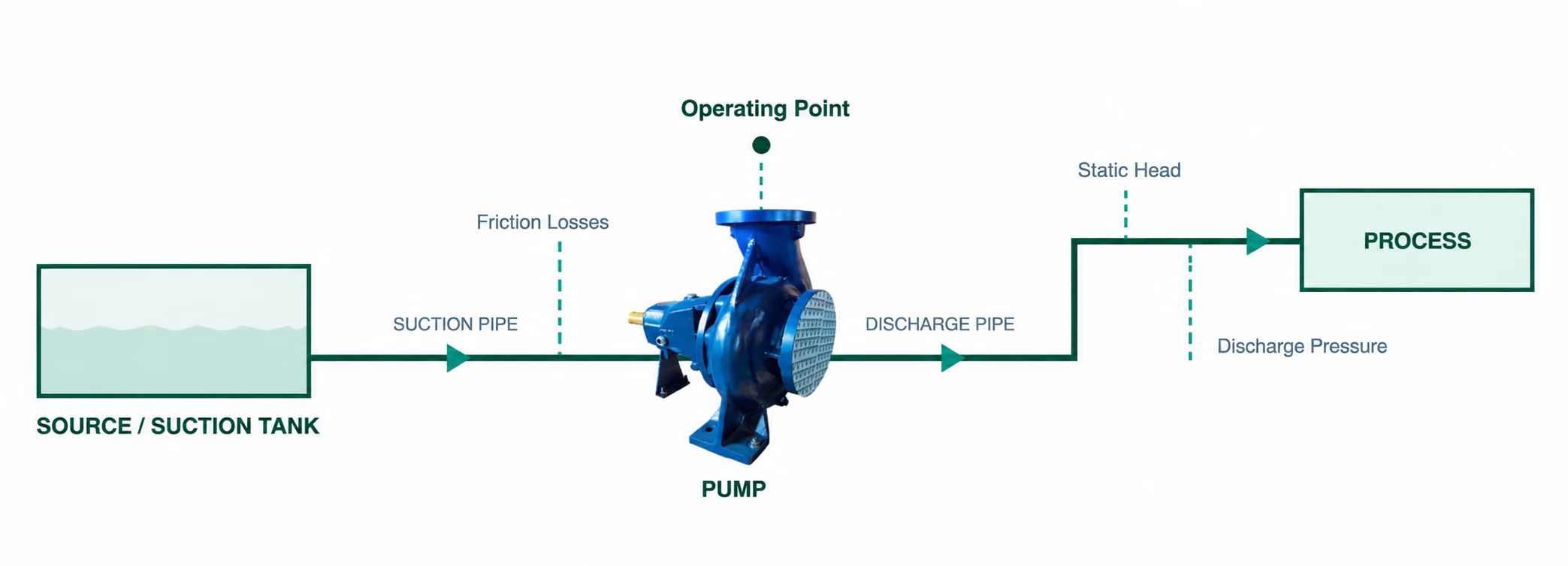
“A pump should be selected against the actual system duty, not flow rate alone.”
UNDERSTAND
THE DUTY POINT
BEFORE
SELECTING THE
PUMP
A pump curve shows the head produced across its flow range. The system curve represents the head the installation requires. Their intersection is the operating point. Selection should place this point within the pump's intended range and appropriately near its Best Efficiency Point (BEP).
Operating too far from this range can contribute to excess energy consumption, vibration, hydraulic instability, seal and bearing stress, and component wear.
THE FLUID CAN CHANGE THE
PUMP SELECTION
Fluid properties are an important part of industrial pump selection, particularly where corrosion, abrasion, solids or viscosity affect pump performance and component life.
CLEAN LIQUIDS
Hydraulic duty and efficiency generally lead selection, with materials matched to water chemistry and temperature.
CORROSIVE FLUIDS
Wetted materials and sealing arrangements must be compatible with the liquid concentration and temperature.
ABRASIVE FLUIDS
Particle hardness, size and concentration influence hydraulic design, wear allowances and material choice.
SOLIDS-BEARING LIQUIDS
Free passage, impeller geometry and solids size must be considered to reduce blockage risk.
HIGH-VISCOSITY LIQUIDS
Viscosity changes pump performance and power demand; published water curves may require correction.
CHECK NPSH BEFORE
FINALISING A CENTRIFUGAL
PUMP
NPSHa is the net positive suction head available from the installation, based on liquid level, pressure, temperature, suction losses and site elevation.
NPSHr is the minimum suction head required by the pump at a given duty. A suitable margin between the two helps avoid cavitation, which can cause noise, vibration, unstable operation and material damage.
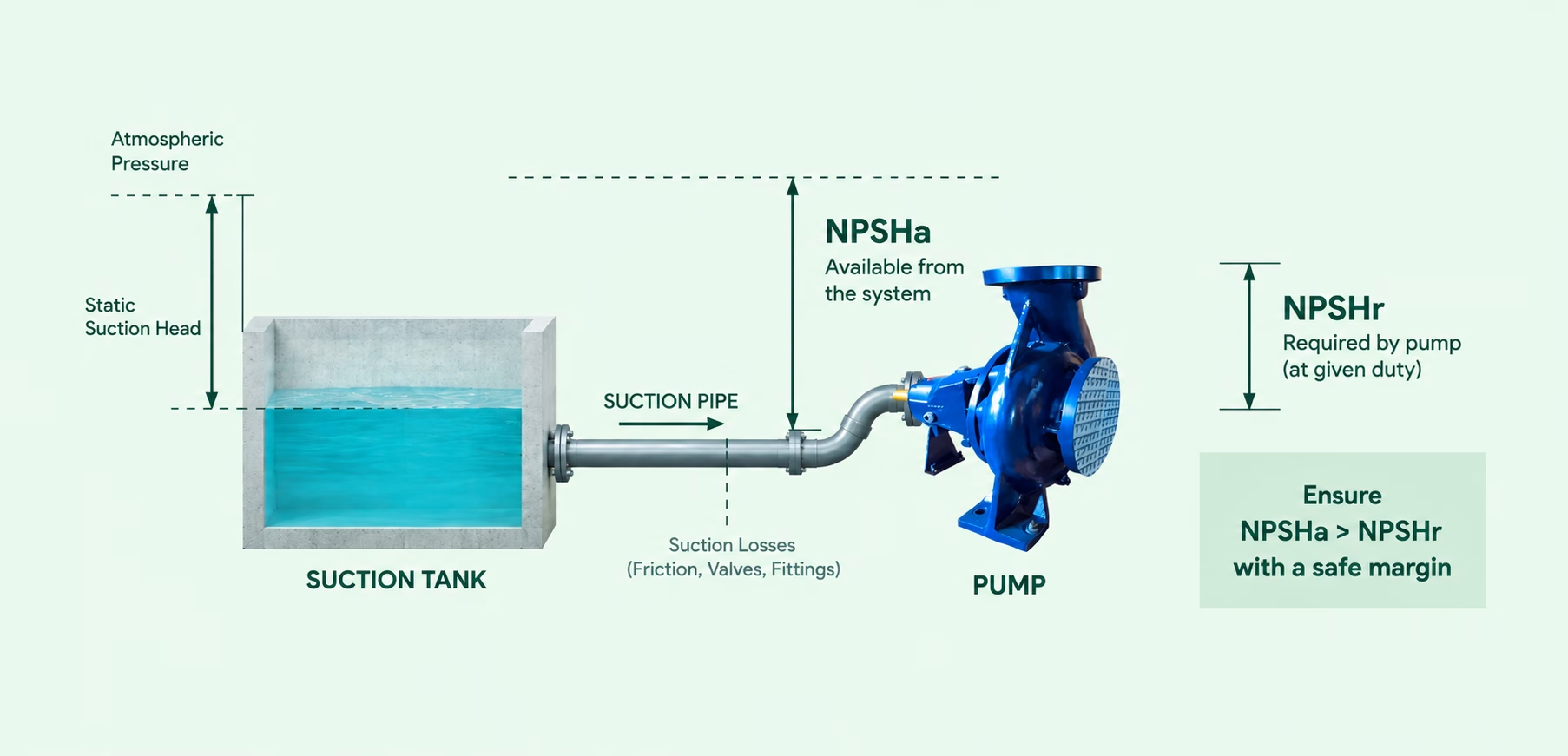
NPSHa should exceed NPSHr with an appropriate margin for reliable centrifugal pump operation.
PUMP MATERIAL SELECTION IS
PART OF PUMP SELECTION
CORROSION
ABRASION
EROSION
TEMPERATURE
SERVICE LIFE
Materials must be selected against the complete service environment—not the fluid name alone. Concentration, temperature, solids and velocity can change corrosion and wear behaviour.
SAM Turbo's integrated manufacturing capability and captive steel foundry support controlled material selection and manufacturing of industrial pump components.
MATCH THE PUMP TYPE TO THE
APPLICATION
Once the duty, fluid and installation conditions are understood, the appropriate pump family can be evaluated.
| APPLICATION | PUMP FAMILY TO EVALUATE | KEY CONSIDERATION |
|---|---|---|
| Clean water / transfer | Water Pumps (WP) / Split Case Pumps | Flow, head and installation |
| High-head service | Multi-Stage Pumps / Split Case 2 Stages | Required head and operating point |
| Abrasive slurry | Slurry Pumps – Double Casing (AR) / Single Casing (ARG) | Solids, wear and material selection |
| Pulp and paper stock | Stock Pumps (TPS) / SPS+T / TPS+H | Stock consistency and fibre content |
| Solids-bearing wastewater | Non-Clog Pumps | Solids passage and clogging risk |
| Sump service | Vertical Sump Pumps (VO) | Sump depth and submergence |
| Vertical process service | Vertical Cantilever Pumps (VG) | Tank geometry and shaft arrangement |
| High-volume transfer | Mixed Flow Pumps (MF) | High flow and relatively lower head |
| Chemical process service | Chemical Pumps (CPC) / Chemical Process Pumps (ECH+N) | Fluid compatibility and sealing |
| API process service | API Process Pumps 7th Edition (SVN) | Process duty and operating conditions |
| M-sand / abrasive mineral service | M-Sand Pumps Double Casing (AARH) | Abrasive solids and wear |
These are pump families to evaluate, not universal selections. Final pump selection depends on the actual duty conditions.
AVOID THESE PUMP SELECTION
MISTAKES
Selecting by flow alone
Flow without total dynamic head does not define the required duty.
Ignoring total head and system losses
Static elevation, friction and equipment losses must all be included.
Oversizing the pump for safety
Excess margin can move operation away from the efficient, stable range.
Ignoring NPSH
Insufficient suction margin can result in cavitation and unstable operation.
Ignoring viscosity
Viscous liquids can reduce flow and head while increasing power demand.
Underestimating solids
Particle size, hardness and concentration affect passage and wear.
Poor material selection
An unsuitable material can shorten service life through corrosion or erosion.
Focusing only on purchase price
Energy use, reliability, maintenance and service life determine whole-life value.
REPLACING AN EXISTING
PUMP? DON'T SELECT BY
NAMEPLATE ALONE.
A replacement pump should be based on the actual duty and current operating conditions. Systems, production requirements and fluid properties may have changed since the original unit was selected.
HOW WE APPROACH
INDUSTRIAL PUMP SELECTION
APPLICATION REVIEW
Understand the process, service objective and constraints.
DUTY DEFINITION
Establish flow, total head and operating range.
FLUID EVALUATION
Review physical, chemical and solids characteristics.
PUMP CONFIGURATION
Evaluate pump family, hydraulics, materials and sealing.
ENGINEERING CONFIRMATION
Confirm selection against installation and operating data.
CONTINUE YOUR PUMP
ENGINEERING REVIEW
FREQUENT QUESTIONS ABOUT
INDUSTRIAL PUMP SELECTION
How do you select an industrial pump? ⌄
What information is required for pump selection? ⌄
What factors affect industrial pump selection? ⌃
How do I calculate pump flow and head? ⌄
Why is NPSH important in pump selection? ⌄
How does fluid viscosity affect pump selection? ⌄
How does solids content affect pump selection? ⌄
How do I select a pump for slurry? ⌄
How do I select a pump for pulp and paper? ⌄
How do I choose a chemical process pump? ⌄
NEED HELP SELECTING
THE RIGHT INDUSTRIAL
PUMP?
Share your application, duty requirements and available operating data with our engineering team for a focused technical discussion.


