

Introduction
Centrifugal Pumps are the backbone of industries such as power generation, mining, steel, chemical processing, fertilizers, pulp & paper, sugar, water treatment, and wastewater management. While these pumps are engineered for continuous and reliable operation, one overlooked factor can drastically reduce their performance and lifespan—NPSH (Net Positive Suction Head).
Insufficient NPSH is one of the primary causes of pump cavitation, leading to excessive vibration, impeller erosion, seal failures, bearing damage, reduced efficiency, and costly unplanned downtime.
At SAM Pumps, we understand that a pump’s performance depends not only on its design but also on proper system engineering. Our industrial pump solutions are designed with optimized hydraulic performance to ensure reliable operation, minimize cavitation risks, and deliver long service life across demanding industrial applications.
This guide explains what NPSH is, why it is important, how cavitation occurs, and how proper pump selection and system design can prevent pump failure.
What is NPSH in Centrifugal Pumps?
NPSH (Net Positive Suction Head) is the amount of pressure available at the suction side of a centrifugal pump above the liquid’s vapor pressure.In simple terms, NPSH ensures that the liquid remains in a liquid state as it enters the pump. If the pressure at the pump inlet falls below the liquid’s vapor pressure, the liquid begins to vaporize, forming bubbles that collapse inside the pump. This phenomenon is known as cavitation.A Centrifugal Pump can only perform efficiently when sufficient NPSH is available.
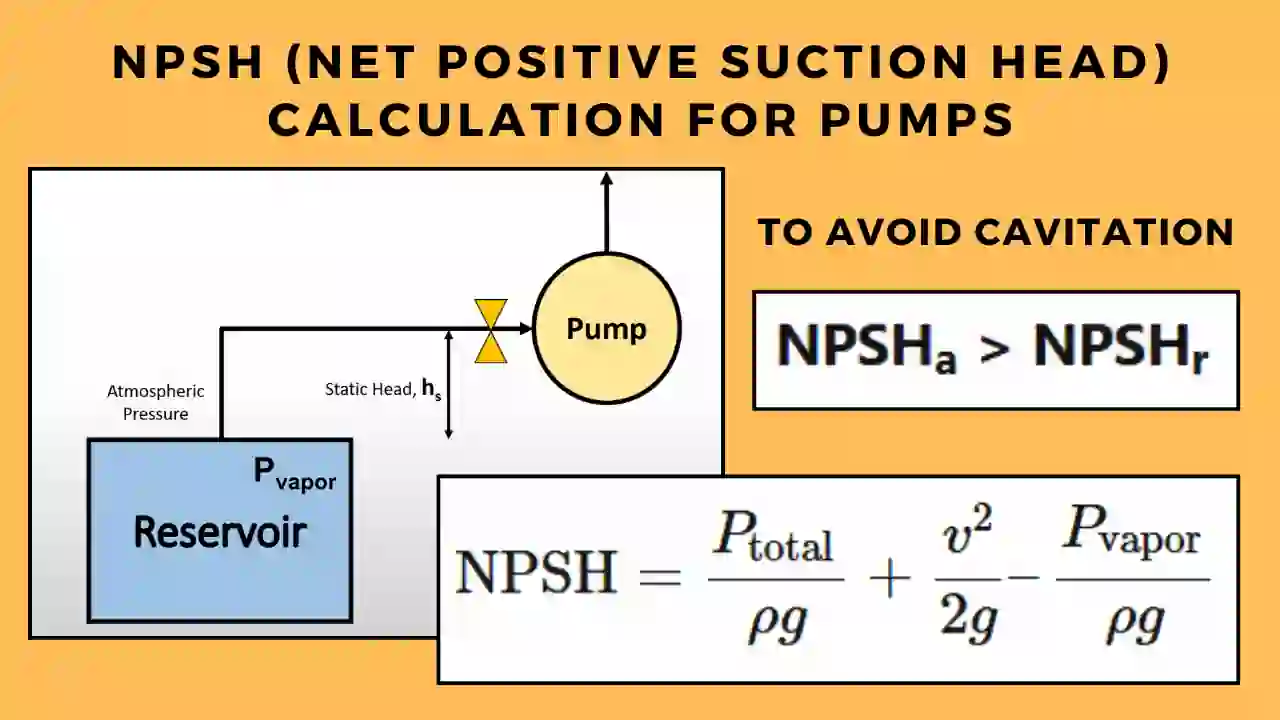
Simply remember:
✔ Adequate NPSH = Smooth and efficient pump operation
✘ Low NPSH = Cavitation, wear, and premature pump failure
Understanding NPSHa and NPSHr
1. NPSH Available (NPSHa)
NPSH Available is the actual pressure available at the pump suction, determined by the overall system design.
It depends on factors such as:
- Liquid level in the tank
- Atmospheric pressure
- Liquid temperature
- Suction pipe length
- Pipe diameter
- Friction losses
- Pump installation height
- The higher the NPSHa, the lower the risk of cavitation.
2. NPSH Required (NPSHr)
NPSH Required is the minimum suction pressure specified by the pump manufacturer to ensure the pump operates without significant cavitation.
It varies depending on:
- Pump design
- Flow rate
- Pump speed
- Impeller geometry
- Every centrifugal pump has an NPSHr curve provided by the manufacturer.
The Basic Rule For safe and efficient operation:
- NPSH Available (NPSHa) must always be greater than NPSH Required (NPSHr).
- Most engineers also maintain a safety margin above the required value to account for changing operating conditions.
What is Pump Cavitation?
- Pump cavitation occurs when the pressure at the pump suction becomes too low, causing the liquid to vaporize into tiny bubbles.
- As these bubbles travel through the impeller, they enter higher-pressure zones and collapse violently. These repeated implosions generate shock waves that gradually damage internal pump components.
- Cavitation is often described as thousands of microscopic explosions occurring inside the pump.
Signs of Pump Cavitation
Early identification can prevent expensive failures. Common symptoms include:
- Loud crackling or gravel-like noise
- Excessive vibration
- Fluctuating discharge pressure
- Reduced flow rate
- Drop in pump efficiency
- Increased energy consumption
- Mechanical seal leakage
- Bearing failures
- Pitting on the impeller surface
- Frequent maintenance requirements
Why is NPSH the #1 Cause of Pump Failure?
When the available suction pressure is insufficient, cavitation begins to damage the pump internally.
1. Impeller Erosion
The collapsing vapor bubbles remove tiny particles from the impeller surface, creating pits that reduce hydraulic efficiency.
2. Seal Damage
Continuous vibration caused by cavitation shortens the life of mechanical seals, resulting in leakage.
3. Bearing Failure
Excessive vibration transfers additional loads to bearings, causing premature wear.
4. Shaft Damage
Hydraulic instability created by cavitation can affect shaft alignment over time.
5. Reduced Pump Efficiency
Damaged impellers lose their hydraulic profile, requiring more energy to achieve the same performance.
6. Increased Maintenance Costs
Unexpected breakdowns, frequent repairs, and replacement of worn components increase operational expenses.
Common Causes of Low NPSH
Several operating conditions reduce the available suction pressure:
1. High Liquid Temperature
Higher temperatures increase vapor pressure, making cavitation more likely.
2. Long Suction Pipelines
Longer pipes create additional friction losses.
3. Undersized Suction Pipes
Small pipe diameters increase liquid velocity and pressure drop.
4. Clogged Suction Strainers
Restricted flow lowers the pressure at the pump inlet.
5. Low Tank Levels
Reduced static head decreases NPSHa.
6. Excessive Pump Speed
Higher speeds often require higher NPSHr.
7. Poor System Design
Too many bends, valves, or fittings increase suction losses.
How to Prevent Pump Cavitation
Preventing cavitation starts with good engineering practices.
Increase NPSH Available
- Raise the liquid level
- Reduce suction lift
- Install larger suction pipes
- Minimize bends and elbows
- Keep suction strainers clean
- Reduce friction losses
- Maintain proper pipe sizing
Select the Right Pump
Choose a centrifugal pump that matches:
- Flow requirements
- System head
- Fluid characteristics
- Operating temperature
- NPSH requirements
- Selecting the correct pump prevents unnecessary stress on the pumping system.
Perform Regular Maintenance
Routine inspections should include:
- Impeller condition
- Bearings
- Mechanical seals
- Suction piping
- Vibration monitoring
- Flow performance
- Preventive maintenance helps identify cavitation before it causes severe damage.
How SAM Pumps Helps Prevent NPSH-Related Pump Failures
At SAM Pumps, every pumping solution is engineered with a focus on hydraulic efficiency, reliability, and long-term performance. With decades of expertise in industrial pump manufacturing, we provide solutions that are designed to operate efficiently even under demanding conditions.
Our engineering team carefully evaluates:
- System flow requirements
- Total dynamic head (TDH)
- Fluid properties
- Suction conditions
- NPSH Available (NPSHa)
- Pump operating point
- Energy efficiency
This approach helps customers select the right pump for their application while minimizing the risk of cavitation and improving operational reliability.
SAM Pumps manufactures a comprehensive range of industrial pumps suitable for industries such as:
- Power Generation
- Chemical Processing
- Fertilizer Plants
- Mining & Mineral Processing
- Steel Industry
- Pulp & Paper
- Sugar Industry
- Wastewater Management
- Oil & Gas
Whether handling clean water, corrosive chemicals, abrasive slurries, or high-temperature fluids, SAM Pumps designs pumping solutions that deliver reliable performance, lower maintenance costs, and extended service life.
Best Practices for Maintaining Proper NPSH
| Best Practice | Benefit |
|---|---|
| Maintain adequate liquid level | Increases NPSHa and reduces the risk of cavitation. |
| Use properly sized suction piping | Minimizes friction losses and improves suction performance. |
| Minimize bends and valves | Reduces pressure drops and maintains higher suction pressure. |
| Clean suction strainers regularly | Prevents flow restrictions and ensures smooth liquid flow. |
| Operate near the Best Efficiency Point (BEP) | Improves pump efficiency while minimizing vibration and cavitation. |
| Monitor vibration levels | Detects cavitation and mechanical issues before major failures occur. |
| Inspect impellers periodically | Prevents severe wear, erosion, and loss of hydraulic efficiency. |
| Select pumps with the correct NPSHr | Ensures reliable, cavitation-free operation and extends pump life. |
Why Choose SAM Pumps?
Selecting the right industrial pump is about more than achieving the required flow and pressure—it’s about ensuring long-term reliability, efficiency, and low lifecycle costs. SAM Pumps combines advanced hydraulic engineering, precision manufacturing, and application expertise to deliver pumping solutions that meet the toughest industrial challenges.
Our strengths include:
- High-efficiency centrifugal pump designs
- Optimized hydraulic performance
- Robust construction for demanding applications
- Expertise across multiple industries
- Reduced maintenance and downtime
- Reliable after-sales support
- Customized pump solutions for complex applications
- By choosing the right pump and maintaining proper NPSH conditions, industries can significantly reduce cavitation-related failures and maximize equipment life.
Practical NPSH Calculation Examples from SAM Pumps
To help engineers understand NPSH calculations under different operating conditions, SAM Pumps provides practical examples for common industrial pumping systems.
Example 1: Open Tank – Suction Lift
In this arrangement, the pump is installed above the liquid level, creating a suction lift.
The calculation considers:
- Atmospheric pressure
- Suction lift
- Friction losses in the suction line
- Liquid vapor pressure
For Example:
- Atmospheric pressure: 1 kg/cm²
- Suction lift: 3 m
- Friction loss: 1 m
- Water temperature: 21°C
- The calculated NPSHa is approximately 5.77 m.
- This shows how increasing suction lift or friction losses directly reduces the available NPSH.

Example 2: Open Tank – Suction Head
When the pump is installed below the liquid level, the static head contributes positively to the available suction pressure.
For a system with:
- Static suction head: 4 m
- Friction loss: 1.2 m
- Installation altitude: 1500 m
- Water temperature: 21°C
- The available NPSH increases to approximately 11.57 m, providing much safer operating conditions and significantly reducing the likelihood of cavitation.

Example 3: Closed Tank Under Vacuum
In vacuum-operated systems, the pressure acting on the liquid surface is lower than atmospheric pressure. This reduces the available suction pressure, making accurate NPSH calculations even more critical.
For a vacuum vessel operating at:
- Vacuum: 600 mm Hg
- Liquid temperature: 40°C
- Friction loss: 1 m
- The calculated NPSHa is approximately 4.94 m.
- These systems require careful pump selection to avoid cavitation.

Example 4: Closed Tank Under Pressure
Pressurized vessels increase the pressure at the pump suction, resulting in a higher NPSHa.
For example:
- Vessel pressure: 0.5 kg/cm²
- Atmospheric pressure: 0.9 kg/cm²
- Friction loss: 1.5 m
- Specific gravity: 0.8
- The available NPSH is approximately 10.33 m, providing excellent suction conditions for the pump.

Why Accurate NPSH Calculations Matter
Proper NPSH calculations help engineers:
- Prevent pump cavitation
- Improve hydraulic efficiency
- Extend impeller and bearing life
- Reduce maintenance costs
- Minimize unplanned downtime
- Optimize pump selection
- Improve overall system reliability
Even small changes in pipe length, elevation, fluid temperature, or suction line design can significantly affect NPSHa. Performing these calculations during the design stage helps ensure reliable pump operation throughout the equipment’s service life.
SAM Pumps: Engineering Reliable Pumping Solutions
At SAM Pumps, every pumping system is evaluated based on its operating conditions to ensure optimum hydraulic performance and reliable service. Our engineering team analyzes critical parameters such as flow rate, total dynamic head (TDH), fluid properties, suction conditions, and NPSH before recommending the most suitable pump for each application.
In addition to manufacturing high-performance industrial pumps, SAM Pumps provides practical engineering resources—including an NPSH Calculation Guide—to help customers design efficient pumping systems and minimize the risk of cavitation.
Whether your application involves power plants, chemical processing, mining, fertilizers, steel, pulp & paper, sugar, oil & gas, or water treatment, SAM Pumps delivers pumping solutions designed for maximum reliability, efficiency, and long service life.
Conclusion
NPSH is one of the most critical parameters affecting the performance and reliability of centrifugal pumps. When the available suction pressure falls below the required level, cavitation can quickly lead to impeller damage, vibration, seal failures, and costly downtime.Understanding the relationship between NPSH Available (NPSHa) and NPSH Required (NPSHr) is essential for selecting the right pump, designing efficient systems, and ensuring long-term operational reliability.
At SAM Pumps, we combine engineering expertise with advanced pump technology to help industries achieve efficient, reliable, and cavitation-free pumping solutions. Whether your application involves clean water, corrosive chemicals, abrasive slurries, or high-temperature fluids, our industrial pumps are designed to deliver exceptional performance with reduced maintenance and extended service life.
Frequently Asked Questions (FAQs)
What is NPSH in centrifugal pumps?
NPSH (Net Positive Suction Head) is the pressure available at the pump suction above the liquid’s vapor pressure. Adequate NPSH prevents cavitation and ensures efficient pump operation.
What causes cavitation in a centrifugal pump?
Cavitation occurs when the suction pressure drops below the liquid’s vapor pressure, causing vapor bubbles to form and collapse inside the pump.
What is the difference between NPSHa and NPSHr?
NPSHa is the pressure available from the system, while NPSHr is the minimum pressure required by the pump. NPSHa should always be greater than NPSHr.
How does SAM Pumps help prevent cavitation?
SAM Pumps designs high-efficiency centrifugal pumps with optimized hydraulic performance and helps customers select pumps based on system conditions, including NPSH requirements, to reduce cavitation and improve reliability.
Which industries benefit from proper NPSH management?
Industries such as power generation, mining, chemical processing, fertilizers, steel, sugar, pulp & paper, water treatment, and wastewater management rely on proper NPSH to ensure efficient and reliable pump operation.


