

Oil and Gas Industry Pumps play a critical role in moving crude oil, hydrocarbons, refined products, process fluids, produced water, and other liquids across the energy value chain. From Upstream production and offshore facilities to midstream pipelines, storage terminals, and Downstream refineries, pumps support essential transfer, circulation, injection, and processing operations.
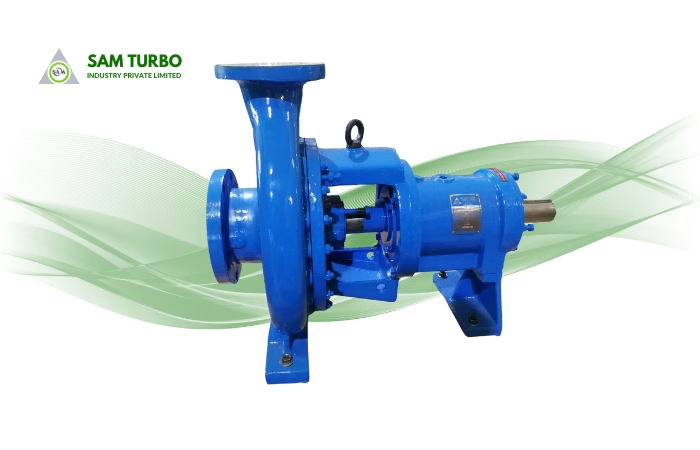
SAM Turbo Industry Pvt. Ltd., established in 1971 in Coimbatore, Tamil Nadu, has more than 55 years of experience in centrifugal pump engineering, manufacturing, and servicing. The company is an ISO 9001:2015 and ISO 45001:2018 certified industrial pump manufacturer and serves industries including Oil & Gas, petrochemical, chemical, power, mining, steel, fertilizer, sugar, and pulp & paper. Its portfolio includes API process pumps, process pumps, horizontal split-case pumps, multistage pumps, vertical pumps, chemical process pumps, and other industrial pumping solutions.For oil and gas applications, SAM Turbo offers API Process Pumps 7th Edition (SVN) designed for high-temperature and high-pressure process and transfer applications, including refineries and oil and gas fields. The pump range is specified for applications such as refineries, onshore and offshore oil & gas facilities, petrochemical processes, and process transfer systems.
Selecting the right pump, however, requires more than simply matching flow and head. Fluid properties, temperature, pressure, viscosity, NPSH, materials, sealing requirements, operating conditions, reliability, and applicable industry standards must all be evaluated. This guide explores how pumps are used across upstream, midstream, and downstream oil and gas operations, the common pump types involved, key selection considerations, API 610 requirements, and practical approaches to improving pump reliability and performance.
What Are Oil and Gas Industry Pumps? Oil and gas industry pumps are centrifugal or positive displacement pumps engineered to transfer, inject, or circulate crude oil, produced water, refined products, and process fluids across upstream production, midstream transport, and downstream refining operations — often under high pressure, elevated temperature, or corrosive and abrasive service conditions.
What Are Oil and Gas Industry Pumps?
Hydrocarbon pumps used in oil and gas facilities are built to handle duties that general industrial pumps are not designed for: flashing liquids near their vapour pressure, fluids with dissolved gas, high differential pressures, elevated temperatures, and streams containing sand, scale, or corrosive components such as H₂S and CO₂. Depending on the application, pumps in this sector may be centrifugal (single or multistage), positive displacement, or vertical sump/cantilever designs.
Typical duties include crude oil transfer, produced-water handling, water and chemical injection, pipeline boosting, tank farm and terminal transfer, cooling water circulation, boiler feed, condensate return, and hydrocarbon circulation within refinery and petrochemical process units. Because many of these services are classified as hazardous, pump selection also has to account for sealing arrangements, material compatibility, and the applicable engineering standard for the project.

Where Are Pumps Used in the Oil & Gas Industry?
The oil and gas industry is generally divided into three segments — upstream, midstream, and downstream — and each segment relies on pumps for a different purpose within the overall process.
| Segment | Typical Operations | Common Pump Duties | Key Challenges |
|---|---|---|---|
| Upstream | Exploration, drilling, wellhead production, separation | Crude transfer, produced-water handling, water/chemical injection | Variable flow, solids, corrosion, remote/offshore operation |
| Midstream | Pipeline transport, storage, terminals | Pipeline boosting, tank farm transfer, loading/unloading | High differential pressure, long continuous run hours, energy use |
| Downstream | Refining, petrochemical processing, product distribution | Hydrocarbon circulation, cooling, boiler feed, condensate, product transfer | High temperature, hazardous/flashing fluids, strict standards compliance |
Pumps for Upstream Oil & Gas Applications
Upstream Oil and Gas Pumps operate closest to the reservoir — at wellheads, gathering stations, and onshore or offshore production facilities. Crude oil arriving from the wellhead is rarely a clean, single-phase liquid; it typically carries produced water, entrained gas, sand, and scale, which makes handling more demanding than a simple liquid-transfer duty.
Common upstream duties include crude oil transfer from separators to storage, produced-water handling and disposal, water injection to maintain reservoir pressure, chemical injection for corrosion or scale control, and general utility services within the production facility. These pumps must tolerate abrasive solids, corrosive produced water, variable flow as well production declines, and — on offshore platforms — compact footprints and continuous duty with limited access for maintenance.
Because upstream fluids can be close to their vapour pressure at suction conditions, available NPSH is frequently the limiting factor in pump selection, and material selection has to account for both erosion from solids and corrosion from dissolved gases.
Pumps for Midstream Oil & Gas Applications
Midstream Oil and Gas Pumps move crude oil and refined products between production, storage, and processing points. This includes pipeline pumping stations, tank farms, storage terminals, and marine loading/unloading facilities. Midstream pumps typically run for very long continuous periods, so reliability and energy efficiency are central selection criteria — even a small efficiency gain compounds significantly over thousands of operating hours.
Pipeline booster pumps must develop high differential pressure to overcome pipeline friction losses and elevation changes over long distances, while terminal and tank farm pumps handle product transfer at lower heads but require precise flow control for custody-transfer accuracy and batch changeovers between different products.
Maintenance planning is critical in midstream service because these pumps are often part of a continuous transport chain; an unplanned outage at a single pumping station can affect throughput across an entire pipeline segment.
Pumps for Downstream Oil & Gas Applications
Downstream Oil and Gas Pumps serve refineries and petrochemical plants, where crude oil is processed into fuels, lubricants, and chemical feedstocks. These are typically the most demanding services in the value chain — high temperatures, flashing hydrocarbons, hazardous or toxic fluids, and strict compliance with recognised engineering standards are the norm rather than the exception.
Typical downstream duties include crude and vacuum unit charge pumps, hot hydrocarbon circulation, reflux and reboiler service, cooling water circulation, boiler feedwater, condensate return, and treated or process wastewater transfer. Many of these duties fall under the category of refinery pumps engineered to API 610 pumps requirements, given the hazardous service classification and the reliability expectations of continuous refinery operation.
Material selection, sealing arrangement, and shaft/bearing design require close attention in downstream service, since fluid temperature, vapour pressure, and hazardous classification directly influence which pump configuration is suitable.
Common Pump Types Used in Oil & Gas
No single pump type is suitable for every oil and gas duty. The right choice depends on flow, pressure, fluid properties, and the specific process the pump serves.
| Pump Type | Typical Application | Key Characteristics | Selection Consideration |
|---|---|---|---|
| API Process Pumps | Refinery and petrochemical hydrocarbon service | Built to API 610 dimensional and mechanical requirements | Confirm project specification requires API 610 compliance |
| End Suction Centrifugal | General transfer, utility and cooling water service | Compact, simple maintenance, moderate flow/head range | Confirm NPSH margin and material compatibility |
| Horizontal Split Case | High-flow pipeline, cooling water, fire water systems | Easy rotor access without disturbing piping, robust for high flow | Best suited where flow is high and head is moderate |
| Multistage Pumps | Pipeline boosting, high-pressure injection service | Multiple impellers generate high differential head | Suited where a single stage cannot meet required head |
| Vertical Pumps | Tank farm, terminal and limited-footprint installations | Space-saving, suited to submerged or in-tank installation | Evaluate submergence, bearing lubrication and shaft length |
| Vertical Sump Pumps | Effluent pits, drainage and wastewater sumps | Handles variable liquid levels and contaminated fluids | Check sump depth, solids content and duty cycle |
| Positive Displacement | Chemical injection, metering, high-viscosity transfer | Delivers near-constant flow independent of discharge pressure | Consider where precise, low-flow dosing is required |
| Slurry Pumps (where applicable) | Sand-laden production fluids, solids handling duties | Heavy-duty wet end designed for erosive/abrasive service | Applicable only where solids content justifies slurry design |
Note: pump type selection should always be validated against the specific flow, head, fluid, and hazardous-service requirements of the application rather than generalised from this table alone.

Pump Type Suitability at a Glance
A quick visual reference for shortlisting pump types by segment — always confirm against actual duty conditions.
| Pump Type | Upstream | Midstream | Downstream |
|---|---|---|---|
| API Process Pumps | ● | ● | ●●● |
| End Suction Centrifugal | ●●● | ● | ● |
| Horizontal Split Case | ● | ●●● | ● |
| Multistage Pumps | ●●● | ●●● | ● |
| Vertical Pumps | ● | ●●● | ● |
| Vertical Sump Pumps | ●●● | ● | ●●● |
| Positive Displacement | ●●● | ● | ●●● |
| Slurry Pumps | ●●● | — | — |
●●● commonly used | ● context-dependent | — rarely applicable
API 610 Pumps in Oil & Gas Applications
API 610 is a standard published by the American Petroleum Institute that defines requirements for centrifugal pumps used in petroleum, petrochemical, and natural gas industries. It covers aspects such as pump construction, baseplate design, shaft sealing arrangements, bearing housings, and testing requirements intended to support long, uninterrupted operating campaigns typical of refinery and petrochemical service.
API 610 is generally referenced on projects where the process specification calls for it — most commonly in refinery, petrochemical, and other hazardous-hydrocarbon services. It is important to distinguish between the standard itself (which sets minimum design and testing requirements), a manufacturer’s pump design (which may or may not be built to meet that standard), and the specific project specification (which defines exactly which clauses of the standard apply for that installation).
Whether a pump needs to be API 610-compliant depends on the project’s engineering specification, not on the pump type alone — some downstream services use API process pumps, while others rely on standard industrial process pumps built to ANSI/ISO dimensional standards. SAM Turbo’s API Process Pumps 7th Edition (SVN) range is designed for this category of hydrocarbon process service; readers comparing the two standards can also refer to our related article on API 610 vs ANSI/ISO 5199.
Key Factors for Selecting Oil & Gas Industry Pumps
Reliable pump selection depends on evaluating the complete operating picture rather than a single parameter. The table below summarises the core factors engineers should confirm before shortlisting a pump.
| Factor | Why It Matters |
|---|---|
| Flow rate | Defines the pump’s required capacity across the operating range |
| Head / differential pressure | Determines staging, impeller design and driver sizing |
| Fluid type | Governs material selection and sealing arrangement |
| Temperature | Affects material limits, seal type and thermal growth |
| Pressure | Determines casing rating and pressure-containing design |
| Viscosity | Influences pump type choice and expected performance derating |
| Vapour pressure / NPSH | Prevents cavitation at the actual suction condition |
| Corrosion | Dictates wetted-part metallurgy and coating requirements |
| Solids content | Determines whether an abrasion-resistant design is needed |
| Operating hours | Continuous duty demands higher reliability margins |
| Hazardous service | Drives sealing configuration and containment requirements |
| Materials | Must match fluid chemistry and service temperature |
| Maintenance | Affects accessibility, spares strategy and downtime cost |
| Energy efficiency | Impacts lifecycle operating cost over continuous run hours |
| Applicable standards | Defines mandatory design, testing and documentation requirements |
Materials, Seals, Bearings & Pump Reliability
Long-term pump reliability in oil and gas service depends as much on the supporting components as it does on the hydraulic design. Corrosion and erosion from produced water, H₂S, CO₂, and entrained solids progressively wear wetted parts, so material compatibility with the actual process fluid — not just a generic fluid category — should be confirmed at the selection stage.
Mechanical seals are frequently the first point of failure in hydrocarbon service; seal type, flush plan, and material selection need to match fluid temperature, pressure, and vapour pressure. Bearings support rotor stability and must be correctly loaded and lubricated to avoid premature wear, while the shaft and coupling assembly requires proper sizing to handle transmitted torque without excessive deflection.
Alignment between pump and driver directly affects vibration levels and seal/bearing life, and should be verified during commissioning and periodically thereafter. Consistent lubrication practices and a structured maintenance programme are what ultimately convert a well-selected pump into a reliably performing asset over its service life.
Common Oil & Gas Pump Problems
| Problem | Common Cause | Warning Sign | Corrective Action |
|---|---|---|---|
| Cavitation | Insufficient NPSH available | Crackling noise, pitted impeller | Review suction system and NPSH margin |
| Vibration | Misalignment, imbalance, cavitation | Rising vibration trend | Realign, rebalance, investigate root cause |
| Seal leakage | Worn faces, incorrect flush plan | Visible leakage, seal chamber heat | Inspect seal, verify flush plan suitability |
| Bearing failure | Poor lubrication, misalignment, overload | Noise, elevated temperature | Correct lubrication schedule, check alignment |
| Misalignment | Installation error, thermal growth | Coupling wear, vibration | Re-align per manufacturer tolerance |
| Corrosion | Fluid-material incompatibility | Wall thinning, pitting | Review metallurgy against process fluid |
| Erosion | Solids or high-velocity flow | Localised wear on impeller/casing | Assess solids handling and flow velocity |
| Overheating | Low-flow operation, bearing distress | Elevated casing/bearing temperature | Check minimum flow and cooling |
| Hydraulic instability | Operation far from BEP | Fluctuating flow/pressure | Review operating point against pump curve |
| Low-flow operation | Throttled or oversized pump | Recirculation, heat build-up | Re-evaluate sizing or add recirculation line |
| High energy consumption | Operating away from best efficiency point | Rising power draw for same output | Review duty point and impeller sizing |
Pump Reliability & Predictive Maintenance
Moving from reactive repairs to condition-based maintenance is one of the most effective ways to improve pump availability in oil and gas service. Vibration monitoring identifies developing mechanical issues such as imbalance, misalignment, or bearing wear before they cause a functional failure. Temperature monitoring on bearings and seal chambers flags abnormal friction or lubrication problems early.
Routine bearing monitoring, seal inspection, and lubrication checks, combined with performance trending of flow and pressure against the original pump curve, help maintenance teams distinguish normal wear from an emerging fault. Reviewing this condition data over time allows repairs to be planned during scheduled outages rather than performed as unplanned emergencies.
Improving Pump Efficiency
Efficiency starts with correct sizing: a pump selected too far from its actual duty point rarely runs efficiently, regardless of its design quality. Operating close to the best efficiency point (BEP), maintaining good shaft alignment, ensuring adequate suction conditions, keeping strainers clean, and reviewing impeller trim against the actual system curve all contribute to lower energy consumption. Periodic review of the hydraulic system — not just the pump in isolation — often reveals opportunities to reduce unnecessary throttling or recirculation losses.
Upstream vs Midstream vs Downstream Pump Selection
| Upstream | Midstream | Downstream | |
|---|---|---|---|
| Main duty | Crude transfer, injection | Pipeline transport, storage transfer | Process circulation, refining |
| Typical fluids | Crude, produced water | Crude, refined products | Hydrocarbons, process/utility fluids |
| Operating environment | Onshore/offshore wellsite | Pipeline stations, terminals | Refinery/petrochemical process units |
| Challenges | Solids, corrosion, variable flow | Long distance head, continuous duty | High temperature, hazardous service |
| Reliability priority | Solids/corrosion resistance | Continuous run reliability | Compliance with process safety standards |
| Pump considerations | Abrasion-resistant materials, NPSH margin | Multistage/split case designs, efficiency | API/process pump design, sealing plan |
Step-by-Step Pump Selection Guide
Identify the fluid and its properties
Define the required flow rate
Determine head / differential pressure
Determine temperature and pressure conditions
Check viscosity and vapour pressure
Evaluate NPSH available against NPSH required
Select the pump configuration
Review materials and sealing arrangement
Check applicable standards and project specifications
Evaluate lifecycle cost, reliability and energy consumption
Engineering Tip: Pump selection should always consider the complete pumping system — suction arrangement, piping layout, and the actual system curve — rather than the pump alone. A pump chosen only against the design point can still underperform once it is installed in the real system.
How SAM Turbo Supports Oil & Gas Pumping Applications
SAM Turbo Industry Pvt. Ltd. has been engineering centrifugal pumps for heavy-duty industrial applications since 1971, bringing 55+ years of manufacturing experience to sectors that include power, chemical, basic metal, mining, sugar, and oil and gas. This cross-industry experience with abrasive, corrosive, and high-temperature services translates directly into the design considerations that matter for hydrocarbon-handling equipment.
Our Industrial Pump Range covers configurations relevant to oil and gas service, including API Process Pumps 7th Edition (SVN), Process Pumps (TCH+N), Horizontal Split Case Pumps (ZM/AD), Multistage Pumps (MD/MDP), and Vertical Sump Pumps (VO). Manufacturing is supported by our own quality assurance processes, and our engineering team works directly with plant and project engineers to match pump selection to the actual operating conditions of each application, rather than offering a one-size-fits-all recommendation.
Frequently Asked Questions
What types of pumps are used in the oil and gas industry?
Oil and gas facilities use API process pumps, end suction and horizontal split case centrifugal pumps, multistage pumps, vertical and vertical sump pumps, and positive displacement pumps, selected according to the specific flow, pressure, and fluid requirements of each duty.
What is the difference between upstream, midstream and downstream pumps?
Upstream pumps handle crude production and injection at the wellsite, midstream pumps move crude and products through pipelines and terminals, and downstream pumps circulate hydrocarbons and process fluids within refineries and petrochemical plants.
What is API 610 and when does it apply?
API 610 is an American Petroleum Institute standard for centrifugal pumps used in petroleum, petrochemical, and natural gas services. It applies when a project’s engineering specification calls for pumps built to its design, materials, and testing requirements, typically in refinery and petrochemical hydrocarbon duties.
Which pump is best for crude oil transfer?
The right pump for crude oil transfer depends on flow, head, fluid properties, and solids content; centrifugal process pumps are common, but the specific configuration should be confirmed against the actual operating conditions rather than assumed.
How do I select the right refinery pump?
Refinery pump selection involves confirming fluid properties, temperature and pressure, NPSH margin, material and sealing requirements, and whether the project specification calls for API 610 compliance, followed by review of lifecycle cost and maintenance needs.
What causes most oil and gas pump failures?
Common causes include cavitation from insufficient NPSH, misalignment, seal leakage from worn faces or an incorrect flush plan, bearing failure due to poor lubrication, and corrosion or erosion from incompatible fluid or solids content.
Why is vibration monitoring important for oil and gas pumps?
Vibration monitoring identifies developing mechanical issues such as imbalance, misalignment, or bearing wear before they escalate into an unplanned failure, allowing repairs to be scheduled rather than performed as emergencies.
What is NPSH and why does it matter in oil and gas pumping?
NPSH (net positive suction head) is the margin available at the pump suction above the fluid’s vapour pressure. Insufficient NPSH causes cavitation, which damages the impeller and reduces pump reliability, and is especially important when handling fluids near their vapour pressure.
How often should oil and gas pumps be maintained?
Maintenance frequency should be based on condition data — vibration, temperature, and performance trends — rather than a fixed calendar interval alone, so that servicing is planned around actual equipment condition.
Can the same pump be used for upstream and downstream service?
Generally no. Upstream, midstream, and downstream duties involve different fluids, pressures, and hazard classifications, so pump configuration, materials, and sealing arrangement need to be selected separately for each application.
Conclusion
Selecting the right pump for an oil and gas application is never a generic exercise. Upstream, midstream, and downstream duties each bring distinct fluids, pressures, and reliability demands, and the pump configuration, materials, sealing arrangement, and applicable standard all need to be matched to the actual operating conditions. A structured selection process — combined with condition-based maintenance and attention to lifecycle cost — is what ultimately delivers safe, reliable pumping performance across the value chain.
Need Help Selecting the Right Pump for Your Oil & Gas Application?
SAM Turbo’s engineering team can support pump selection, troubleshooting, and maintenance planning for upstream, midstream, and downstream requirements.


