

Introduction
Parallel vs Series Pump Operation is a critical consideration when designing multi-pump systems for industrial applications where a single pump may not adequately meet the required flow or head. The way pumps are arranged can significantly influence overall system performance, operating flexibility, efficiency and reliability. Factors such as Flow Requirements, Total Head, System Resistance, Pump Performance, Suction Conditions and Operating Conditions must therefore be carefully evaluated before selecting a suitable pump arrangement.
Pump systems operating in parallel and series offer different advantages depending on the application and system requirements. Parallel operation is generally used when higher flow capacity is required, while series operation is used when higher head is needed. Selecting the right configuration is not simply about adding more pumps; it requires a thorough understanding of the complete pumping system and its operating conditions. With 55+ years of experience in industrial centrifugal pump engineering and manufacturing, SAM Turbo understands the importance of application-focused Pump Selection and Multi-Pump System Design for demanding industrial services.
SAM Turbo’s centrifugal pump range includes configurations directly relevant to multi-pump system design — from single-stage units suited to parallel installation to Split Case 2-Stage (TU) and Multi-Stage (MD/MDP) pumps built on the same head-addition principle used in series arrangements. Our Pumps Selection guide is a useful starting point for evaluating flow and head requirements before deciding on a multi-pump arrangement.
What Is Multi-Pump Operation?
Multi-Pump Operation means running two or more pumps together to meet a duty that a single pump cannot deliver efficiently — or at all. A single pump may fall short for several reasons: the required flow exceeds what one unit can economically provide, the required head is beyond a single pump’s practical design limits, the process needs standby capacity for reliability, or demand varies enough over time that one large pump would spend most of its life operating far from its Best Efficiency Point (BEP).
Rather than specifying one oversized pump, engineers combine multiple pumps in one of two arrangements: parallel, to add flow, or series, to add head. The right choice depends entirely on which parameter — flow or head — is the actual constraint in the system.
Pumps in Parallel
Parallel operation connects two or more pumps so they draw from a common suction source and discharge into a shared header. Each pump contributes flow to the same discharge line, so the combined output is used to meet higher flow requirements than a single pump can supply — for example, matching peak water demand, cooling load, or process throughput.
Because all pumps discharge into the same header, each operates at the same discharge pressure/head at any given moment. Flow distribution between the pumps depends on how closely their individual characteristic curves match — pumps with different curves will not share flow evenly, and a mismatched pump can be pushed toward a low-flow, inefficient, or even unstable operating region. Non-return (check) valves on each pump’s discharge branch are standard practice, preventing backflow through an idle or stopped pump.
Parallel systems are also well suited to variable demand. Rather than running a single large pump throttled far from its BEP during low-demand periods, plants often stage two, three, or more smaller pumps on and off — or pair fixed-speed units with a variable frequency drive (VFD) on one pump — to track the demand curve while keeping each running unit closer to its efficient operating range.
Advantages:
Limitations:
Pumps in Series
Series operation connects pumps so the discharge of the first pump feeds directly into the suction of the next. Every pump in the train handles the same flow rate, but each one adds its own head to what came before it — this is how series arrangements meet higher head requirements than a single pump can generate, such as long-distance transmission pipelines or high-pressure boiler feed duties.
Because the second pump’s suction pressure equals the first pump’s discharge pressure, downstream pumps and piping must be rated for progressively higher pressure. A multistage pump is essentially a series arrangement of impellers built into a single casing — the same head-addition principle applies whether the “stages” are separate pumps in a pipeline or impellers within one unit like SAM Turbo’s Split Case 2-Stage (TU) or Multi-Stage (MD/MDP) pump ranges.
This progressive pressure build-up has direct design implications: casing, sealing, and piping specifications typically increase from the first stage to the last, and isolation valves around each pump are needed so that one unit can be taken out for maintenance without depressurizing or shutting down the entire train.
Advantages:
Limitations:
Parallel vs Series Pump Operation
| Property | Parallel Pumps | Series Pumps |
|---|---|---|
| Main Purpose | Increase flow | Increase head |
| Flow | Adds at the same head | Same flow through every pump |
| Head | Same head as a single pump at that flow | Adds at the same flow |
| System Arrangement | Common suction, shared discharge header | Discharge of one feeds suction of next |
| Typical Applications | Water distribution, cooling systems, variable demand duties | Booster stations, boiler feed, high-head process transfer |
| Key Considerations | Matched curves, non-return valves, flow sharing | Pressure rating, NPSH at each stage, full-flow sizing |
How Pump Curves Change in Parallel and Series
Combined Pump Curves are built differently for each arrangement. For parallel operation, the combined curve is created by adding the flow rates of each pump at the same head — a horizontal summation across the curve. For series operation, the combined curve is created by adding the heads of each pump at the same flow — a vertical summation.
Neither combination tells you the actual operating point on its own. The real duty point is set by where the combined pump curve intersects the system curve — the relationship between flow and the head the system demands, made up of static head plus friction losses that rise roughly with the square of flow. This is why adding a second identical pump in parallel rarely doubles flow: as flow increases, system head rises too, pushing the operating point up a steeper section of the system curve where each pump delivers less than its rated flow. The same logic applies in series — the head gain from a second pump depends on where the system curve sits, not simply on adding nameplate heads.
How to Choose Between Parallel and Series Pumps
Required Flow
Higher volume requirement → Parallel
Required Head
Higher pressure/elevation → Series
System Resistance
Check static head and friction losses before adding pumps.
Operating Conditions
Continuous or intermittent duty affects pump staging.
Pump Efficiency
Check the operating point and proximity to BEP.
Reliability
Evaluate redundancy, bypass and isolation requirements.
Maintenance
Ensure pumps or stages can be isolated for servicing.
Future Capacity
Consider future demand and possible pump additions.
→ PARALLEL
→ SERIES
7 COMMON MULTI-PUMP SYSTEM MISTAKES
Linear Sizing Assumption
Do not assume flow or head increases linearly with every added pump.
System Curve Ignored
Always evaluate combined pump performance against the system curve.
Poor Flow Distribution
Mismatched pump curves or unequal pipe runs can affect parallel operation.
Operating Away From BEP
Partial-load staging can move pumps away from their efficient operating region.
Incorrect Valve Arrangement
Check non-return and isolation valve requirements.
Suction Conditions Overlooked
Pay particular attention to NPSH requirements in series arrangements.
Poor Control Strategy
Poor sequencing can lead to short cycling and inefficient staging.
ENGINEERING TAKEAWAY
Do not select a multi-pump arrangement based only on flow or head.Evaluate the complete system curve, pump operating point, efficiency,reliability, maintenance requirements and future capacity before final selection.
Applications of Parallel and Series Pump Systems
In power plants, boiler feed and cooling water systems commonly use parallel pumps to provide redundancy and match variable thermal loads, while high-pressure feedwater duties often rely on multistage or series arrangements to reach the required head. In water systems, treatment plants and distribution networks use parallel pumps to track demand that varies through the day, while long-distance transmission mains use series-connected booster stations to maintain pressure over distance. In process industries, parallel arrangements support high-volume circulation and cooling duties with built-in standby capacity, while series arrangements are used where process fluid must be transferred at high pressure over long pipeline runs.
The common thread across all three sectors is that the arrangement follows the constraint, not the other way around. A plant may use parallel pumps on one duty and series (or multistage) pumps on another within the same facility, depending on what each specific system actually demands.
What EPC and Procurement Teams Should Check
SAM Turbo’s Approach to Industrial Pump Selection
SAM Turbo Industry Pvt. Ltd. brings 55+ years of experience in industrial centrifugal pump engineering and manufacturing. Our approach to pump selection considers the actual system and operating conditions — flow, head, suction conditions, and duty profile — rather than treating pump sizing as a catalog lookup.
This is directly relevant to multi-pump system design: our Split Case 2-Stage (TU) pumps and Multi-Stage (MD/MDP) pumps are built on the same head-addition principle used in series pump trains, offering higher head capability within a single, compact unit. For EPC teams and consultants evaluating flow or head requirements for a multi-pump system, our Pumps Selection guide is a useful starting reference alongside the full Industrial Pumps range.
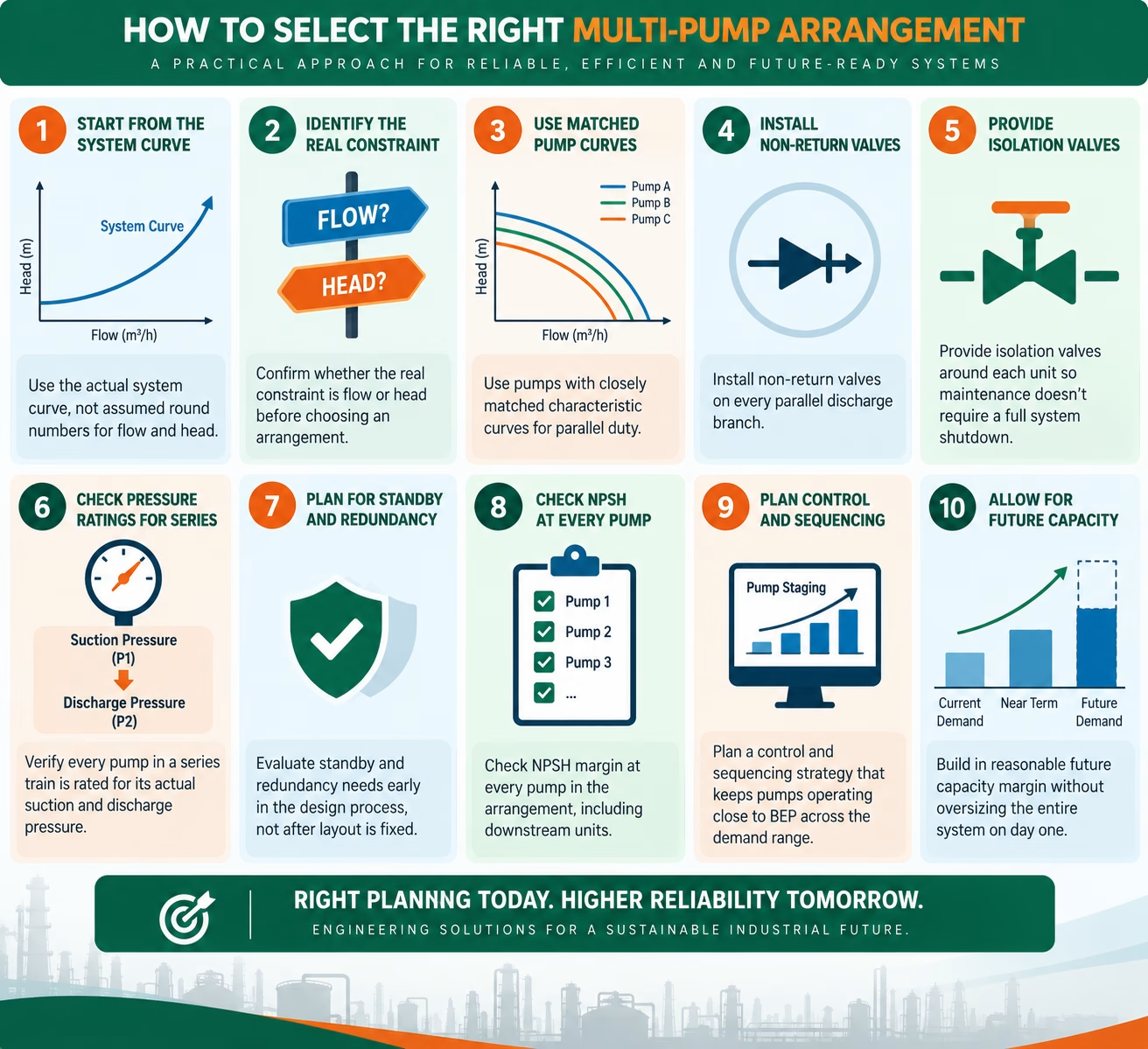
How to Select the Right Multi-Pump Arrangement
Frequently Asked Questions
What is parallel pump operation?
What is series pump operation?
Do parallel pumps increase flow?
Do series pumps increase head?
Can pumps be operated in parallel?
Can pumps be operated in series?
What is the difference between series and parallel pumps?
How do pump curves change in parallel operation?
How do pump curves change in series operation?
How do you select the right multi-pump arrangement?
Conclusion
Parallel vs Series Pump Operation plays an important role in achieving the required flow and head in multi-pump industrial systems. While parallel pump arrangements can provide increased flow capacity, series arrangements can develop higher head to overcome demanding system resistance. Factors such as Flow, Head, System Curve, Pump Curve, Operating Point, Efficiency and Reliability should therefore be carefully evaluated before finalizing the pump configuration.
The right multi-pump arrangement depends on the specific application, process requirements and operating conditions rather than simply increasing the number of pumps. With 55+ years of experience in industrial centrifugal pump engineering and manufacturing, SAM Turbo focuses on application-specific Pump Selection and System Solutions to support reliable and efficient pumping performance across demanding industrial applications.
Whether a project calls for parallel pumps to meet variable flow demand or a Split Case 2-Stage (TU) or Multi-Stage (MD/MDP) pump to reach a higher head in a single unit, evaluating the complete system against the full Industrial Pumps range remains the starting point for a reliable multi-pump design.
Evaluating a Multi-Pump System for your project?
SAM Turbo’s Engineering team can help EPC and design teams work through Flow, Head and System curve requirements for Parallel or Series pump arrangements.


