

Procurement & EPC teams play a critical role in selecting industrial pumps that meet both immediate project requirements and long-term operational demands. While the initial purchase price is often an important consideration, it represents only one part of the overall investment. Energy consumption, maintenance requirements, reliability, downtime, spare parts and replacement costs can significantly influence the total cost of operating a pump throughout its service life.
This is where the concept of Total Cost of Ownership (TCO) becomes essential. A lifecycle-based evaluation helps industrial buyers and project teams look beyond the initial equipment cost and make more informed decisions based on long-term value, operational efficiency and reliability.
For industries where pumping systems operate continuously or under demanding conditions, selecting the right pump can have a significant impact on operating and maintenance costs. With more than 55 years of Experience in Industrial Pump Engineering and manufacturing, SAM Turbo understands the importance of application-focused pump selection and reliable pumping solutions. This guide provides an educational overview of the key factors that procurement professionals and EPC teams should consider when evaluating the total cost of ownership of industrial pumps.
What Is Total Cost of Ownership in Industrial Pumps?
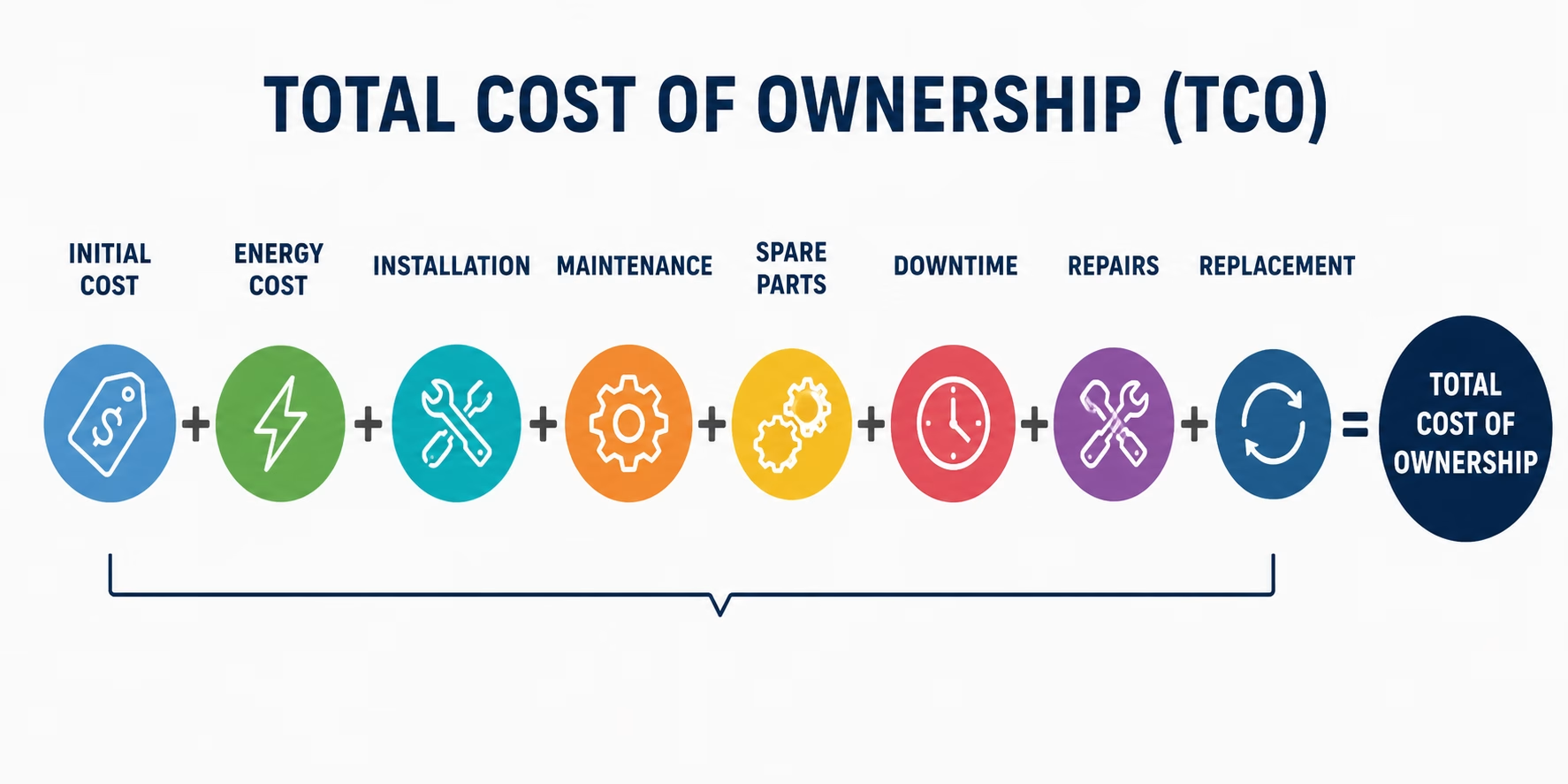
Total Cost of Ownership (TCO) is the complete cost of owning and operating a pump across its lifecycle — not just the invoice value at the time of purchase. It combines every cost the pump generates from procurement through eventual replacement:
Initial Cost + Energy Cost + Installation + Maintenance + Spare Parts + Downtime + Repairs + Replacement = Total Cost of Ownership
Because pumps are often long-lived, continuously running assets, the costs that accumulate after purchase — energy draw, maintenance labor, spare parts, unplanned downtime — can outweigh the original purchase price many times over across the equipment’s service life. This is why the lowest-priced pump on a quotation isn’t automatically the most economical choice once the full lifecycle is considered.
The Pump Cost Iceberg
The purchase price is what’s visible on a quotation. Most of a pump’s actual lifecycle cost lies beneath the surface.
(what you see on the quotation)
Lifecycle Costs (often unseen at purchase)
→ Installation & commissioning
→ Energy consumption over years of operation
→ Routine and preventive maintenance
→ Spare parts and consumables
→ Unplanned repairs
→ Downtime and production losses
→ Eventual replacement
Why Purchase Price Alone Can Be Misleading
A lower initial purchase price can lead to higher overall costs when it comes bundled with poor hydraulic efficiency, excessive energy consumption, frequent maintenance needs, harder-to-source spare parts, higher unplanned downtime risk, an incorrect match to the actual duty, or a shorter expected service life. None of these show up on the purchase order, but all of them show up on the operating budget.
Key Cost Components of Pump Total Cost of Ownership
| Cost Component | What It Includes | Long-Term Impact |
|---|---|---|
| Initial Purchase Cost | Equipment price, freight, taxes | One-time, but sets the baseline for evaluation |
| Installation & Commissioning | Civil work, alignment, startup verification | Poor installation raises future maintenance costs |
| Energy Consumption | Electricity to run the motor over operating hours | Often the largest recurring cost for continuous duty |
| Maintenance Costs | Lubrication, inspection, seal/bearing service | Recurring; scales with reliability and duty severity |
| Spare Parts | Seals, bearings, wear rings, impellers | Availability and lead time affect downtime risk |
| Repair Costs | Unplanned corrective repairs | Higher when reliability issues go unaddressed |
| Downtime & Production Losses | Lost output during failure or repair | Often the least visible but most costly factor |
| Operational Costs | Monitoring, operator time, condition checks | Ongoing, tied to how the pump is operated day to day |
| Replacement Costs | End-of-life replacement or major overhaul | Comes sooner if the pump was poorly matched to duty |
Energy Costs: The Largest Lifecycle Expense?
For pumps that run continuously or for long hours, energy consumption is frequently the single largest lifecycle cost component — simply because electricity is drawn every hour the motor runs, year after year, while the purchase price is paid once. How much energy a pump consumes depends on its hydraulic efficiency, how close its actual operating point sits to its Best Efficiency Point (BEP), the resistance of the system it’s installed in, correct sizing at the design stage, total operating hours, whether demand is constant or variable, and the efficiency class of the driving motor.
In applications where flow demand genuinely varies over time, a variable frequency drive can help match pump speed to actual demand rather than relying on valve throttling, which wastes energy across a fixed-speed pump. That said, a VFD is not a universal fix — it adds cost and complexity, and its value depends on the specific duty cycle and how much the flow requirement actually varies. Any energy savings should be evaluated against real operating data for the application rather than assumed in advance.
How Pump Selection Influences TCO
Selecting a pump correctly against required flow, total head, fluid properties, temperature and pressure, solids content, corrosion and abrasion potential, expected operating hours, duty variation and the surrounding system design isn’t just a technical exercise — it’s a direct lever on lifecycle cost. A pump mismatched to its duty runs away from its efficient operating range, consuming more energy, wearing faster, needing more frequent maintenance, and carrying a higher risk of unplanned downtime than one selected correctly from the start. Learn more in SAM Turbo’s Pump Selection Guidance.
Maintenance, Reliability and Lifecycle Costs
Bearing Failures, Mechanical Seal Failures, Cavitation, Misalignment, Vibration, Improper Lubrication, and Prolonged Operation away from the Pump’s Preferred duty range all carry direct financial consequences — in parts, labor, and often in downtime. These issues rarely appear in isolation; a pump running consistently off its BEP, for example, is more prone to vibration, which accelerates both bearing and seal wear.
→
→
→
For a deeper look at alignment specifically, see SAM Turbo’s guide to Centrifugal pump alignment best practices, and for ongoing operating guidance, see Operation Tips and Maintenance Tips.
The Hidden Cost of Pump Downtime
A pump failure rarely stops at the cost of the repair itself. It can halt production, delay project schedules on EPC contracts, require emergency labor at premium rates, expose the plant to spare parts availability risk if the right part isn’t on hand, and in some cases introduce safety or operational risk depending on the process involved. This is precisely why procurement teams evaluating a pump purchase should weigh reliability and serviceability alongside price — a marginally cheaper pump that fails more often, or takes longer to source parts for, can cost considerably more once downtime is factored in.
How Procurement Teams Can Evaluate Pump TCO
TCO Comparison: Low Initial Cost vs Long-Term Value
| Factor | Low Initial Cost Approach | Lifecycle Value Approach |
|---|---|---|
| Purchase price | Prioritized as the primary decision factor | One input among several evaluated together |
| Energy efficiency | Often secondary to upfront cost | Evaluated against actual operating hours and duty |
| Reliability | Assessed after failures occur | Evaluated proactively before purchase |
| Maintenance | Often reactive | Planned and budgeted from the outset |
| Downtime risk | Not factored into the purchase decision | Weighed alongside price and specification |
| Spare parts | Availability considered only after a failure | Confirmed before commitment |
| Long-term operating costs | Discovered gradually over the pump’s life | Anticipated and planned for at purchase |
A Simple Framework for Calculating Pump TCO
TCO = Initial Investment + Installation + Energy + Maintenance + Repairs + Downtime + Replacement Costs
The actual figures behind this formula depend heavily on operating conditions, local energy prices, maintenance history and the specific application — there’s no universal number that applies across industries or pump types. To illustrate how the framework is applied, consider a purely hypothetical example (not an actual SAM Turbo project or figures): a plant comparing two pumps for a continuous-duty water transfer application might estimate purchase price, expected annual energy draw at the anticipated operating hours, an approximate annual maintenance budget based on the manufacturer’s service recommendations, and a rough allowance for downtime risk based on spare parts lead time — then compare the two pumps on that combined basis rather than price alone. The exercise is illustrative only; real evaluations should use the buyer’s actual energy tariffs, maintenance data and operating profile.
Total Cost of Ownership Considerations for EPC Projects
EPC teams have a particular opportunity — and responsibility — to build TCO thinking into a project from the start, because early engineering decisions shape operating and maintenance costs for years afterward. This applies during pump selection, project design, technical evaluation of competing vendors, installation planning, Commissioning, and handover. A pump specified purely to meet the lowest capital cost line item in a bid can quietly become the client’s most expensive long-term liability if lifecycle factors weren’t part of the technical evaluation.
SAM Turbo’s Engineering Approach to Lifecycle Value
SAM Turbo Industry Pvt. Ltd. brings more than 55 years of centrifugal pump industry experience to industrial pump engineering and manufacturing. That experience is reflected in:
Selecting the appropriate pump category for the application — whether that’s an API process pump for hydrocarbon service, a Chemical Process Pump for corrosive fluids, a Slurry Pump for abrasive mining duty, or a Multi-Stage Pump for high-head power plant applications — is a foundational step in supporting efficient, reliable long-term operation. No single pump category is universally correct; the right fit depends on the specific application.
Educational Example
Consider a Hypothetical Procurement Scenario: A Plant identifies a pump requirement for a continuous-duty process transfer application. The team analyzes the application’s flow, head and fluid characteristics, selects a pump category suited to that duty, evaluates the initial cost of the shortlisted options, assesses expected energy consumption at the anticipated operating hours, reviews maintenance requirements and spare parts availability, weighs the downtime risk of each option, compares the pumps on a lifecycle basis rather than price alone, and arrives at a final decision. This example is illustrative only and does not represent any actual SAM Turbo customer or project.
How to Reduce Total Cost of Ownership of Industrial Pumps
Ten practical levers, working together around one goal.
Select the Right Pump
Avoid Oversizing
Operate Near Duty Range
Monitor Performance
Maintain Alignment
Proper Lubrication
Prevent Cavitation
Condition Monitoring
Preventive Maintenance
Evaluate Energy Use
Frequently Asked Questions
What is total cost of ownership in industrial pumps?
How is pump TCO calculated?
Why is pump energy efficiency important?
Is the cheapest pump always the most cost-effective option?
How does pump maintenance affect TCO?
How does downtime increase pump lifecycle costs?
How can correct pump selection reduce operating costs?
Do VFDs help reduce pump operating costs?
What should procurement teams consider when purchasing an industrial pump?
How can EPC teams evaluate pump lifecycle costs?
Conclusion
Procurement & EPC teams must look beyond the initial purchase price when evaluating an industrial pump. A comprehensive assessment of energy consumption, maintenance requirements, reliability, downtime, spare parts and replacement costs provides a clearer understanding of the pump’s actual lifecycle value.
The most economical choice is not always the pump with the lowest upfront cost. Selecting a pump based on the correct application requirements, operating conditions and long-term performance expectations can help reduce avoidable operating and maintenance costs throughout its service life.
Initial Investment → Energy Consumption → Maintenance → Reliability → Downtime → Long-Term Lifecycle Value
By adopting a Total Cost of Ownership approach, industrial buyers and EPC professionals can make more informed and sustainable pump procurement decisions. With extensive experience in industrial pump engineering and manufacturing, SAM Turbo Supports a wide range of industrial applications through application-focused pumping solutions and engineering expertise.
Need support in selecting the Right Industrial Pump for Your Application?
Connect with SAM Turbo’s Engineering Team to discuss your operating requirements and pumping system needs.


