

Pump Casing Material Selection is a critical engineering consideration that directly influences the reliability, safety, performance and service life of an industrial pumping system. A pump casing must not only contain the operating pressure and guide the fluid through the pump but also withstand demanding conditions created by the pumped fluid and the surrounding operating environment. Factors such as Fluid Chemistry, Temperature, Pressure, Corrosion, Abrasion, Suspended Solids and Mechanical Stresses must therefore be carefully evaluated before selecting a suitable casing material.
Materials such as cast iron, cast steel and duplex stainless steel offer different advantages in terms of mechanical strength, corrosion resistance, durability and application suitability. Selecting the right material is not simply about choosing the strongest or most expensive option; it requires a thorough understanding of the pumping application and operating conditions. With 55+ years of experience in industrial centrifugal pump engineering and manufacturing, SAM Turbo understands the importance of application-focused Pump Design and Material Selection for demanding industrial services.
What Is a Pump Casing and Why Does Material Selection Matter?
The Pump Casing is the pressure-containing shell that surrounds the impeller, directs fluid into and out of the pump, and provides structural support for the rotating assembly and bearings. It’s the single component most continuously exposed to the pumped fluid under pressure, which makes its material selection directly tied to reliability, safety and service life. Cast iron, cast steel and duplex stainless steel are the three materials most frequently specified for industrial pump casings, each suited to a different combination of operating conditions.
Why Pump Casing Material Selection Is Important
A Casing Material mismatched to its service can fail in several ways: corrosion thinning the wall over time, erosion from suspended solids wearing internal surfaces, leakage developing at pitted or cracked areas, or outright cracking under mechanical or thermal stress the material wasn’t suited to withstand. Each of these translates directly into increased maintenance frequency, unplanned downtime and, eventually, premature replacement — meaning casing material selection is not just a technical specification but a direct input into the pump’s total lifecycle cost.
Key Factors That Influence Pump Casing Material Selection
Selection should weigh the pumped fluid’s characteristics, operating temperature, operating pressure, required corrosion resistance, abrasion and erosion potential, mechanical strength needs, manufacturing and maintenance requirements, and lifecycle cost together — not in isolation.
Fluid Analysis → Operating Conditions → Material Compatibility → Mechanical Requirements → Lifecycle Cost
Cast Iron Pump Casings
Cast Iron is widely used for general-duty pump casings thanks to its cost-effectiveness, good castability, and ease of machining into complex casing geometries. It handles moderate pressures and mild, non-aggressive fluids like clean water and many general process liquids well. Its limitations show up in corrosive or chemically aggressive services, where cast iron corrodes far more readily than steel-based alternatives — and even within “cast iron” as a category, the specific grade (grey iron, ductile iron, and so on) significantly affects strength and suitability, so grade selection matters as much as the base material choice.
Cast Steel Pump Casings
Cast Steel offers meaningfully higher mechanical strength and toughness than cast iron, along with better resistance to mechanical shock and higher pressure-handling capability — making it the frequent choice for higher-pressure or higher-temperature services and applications where impact resistance matters. However, higher mechanical strength does not automatically mean higher corrosion resistance; carbon and low-alloy cast steels can still corrode readily in aggressive chemical environments unless specifically alloyed or coated for that purpose. Cast steel solves a mechanical problem, not necessarily a chemical one.
Duplex Stainless Steel Pump Casings
Duplex Stainless steel combines high mechanical strength with strong corrosion resistance, including notably good resistance to chloride-containing fluids that would rapidly attack standard austenitic stainless steels through pitting or stress corrosion cracking. It’s a strong fit for demanding chemical, marine and high-chloride environments. That performance comes at a cost, though: duplex stainless steel carries a significantly higher material cost than cast iron or standard cast steel, and its manufacturing — casting, welding and heat treatment — requires tighter process control. It should not be treated as the automatic “best” choice for every application; its added cost is only justified where its specific corrosion resistance is genuinely needed, and its compatibility still depends on the exact fluid chemistry involved.
Cast Iron vs Cast Steel vs Duplex Stainless Steel
Cast Steel
Duplex Stainless Steel
Mechanical Strength
Corrosion Resistance
Pressure Capability
Toughness
Abrasion Resistance
Note: dedicated wear-resistant alloys (e.g. high-chrome) outperform all three for severe abrasive/slurry duty
Chloride Resistance
Relative Cost (lower bar = lower cost)
| Property | Cast Iron | Cast Steel | Duplex Stainless Steel |
|---|---|---|---|
| Mechanical Strength | Moderate | High | High |
| Corrosion Resistance | Low | Low–Moderate | High |
| Pressure Capability | Moderate | High | High |
| Toughness | Lower (brittle) | High | High |
| Abrasion Resistance | Moderate (grade-dependent) | Moderate | Moderate |
| Chloride Resistance | Low | Low | High |
| Relative Cost | Low | Moderate | High |
| Typical Applications | Water, general process fluids | Higher pressure/temperature service, mechanical shock duty | Corrosive, chloride-rich chemical and marine environments |
Corrosion and Its Impact on Pump Casings
Corrosion isn’t a single mechanism. Uniform Corrosion thins the material evenly over the wetted surface. Pitting Corrosion attacks localized spots, often in the presence of chlorides, creating deep, hard-to-detect points of weakness. Crevice Corrosion occurs in tight gaps such as gasket faces or fastener contact points where stagnant fluid concentrates aggressive species. Galvanic Corrosion arises when dissimilar metals in electrical contact accelerate corrosion of the less noble material. Fluid chemistry, temperature and the specific material grade all influence which mechanism dominates — and it’s worth being clear that stainless steel, including duplex grades, is not automatically suitable for every chemical application; the wrong stainless grade in a chloride-rich or reducing acid environment can still fail.
Erosion and Abrasion in Mining and Slurry Applications
Corrosion, Erosion and Abrasion are related but distinct: corrosion is a chemical attack on the material, erosion is material loss from fluid impingement (often carrying fine particles), and abrasion is material loss from solid particles sliding or impacting against a surface. In mining and slurry applications, the severity depends heavily on particle size, particle hardness, solids concentration and flow velocity — a slurry with fine, low-hardness particles at low velocity behaves very differently from one with coarse, hard particles at high velocity. For severe abrasive duty, dedicated wear-resistant designs generally outperform standard cast iron, cast steel or duplex stainless steel casings; see SAM Turbo’s Slurry Pumps – Double Casing (AR) for a purpose-built approach to this category of service.
Pump Casing Materials for Chemical Applications
Chemical Pump Material Selection must account for the specific chemical’s concentration, the fluid’s operating temperature, its corrosive properties, and the compatibility of the candidate material with that exact combination — the same base chemical can behave very differently at different concentrations and temperatures. Critically, the casing is only one wetted component: the impeller, shaft, mechanical seal faces, gaskets and O-rings are all in direct contact with the fluid and must each be individually evaluated for compatibility, since a single incompatible component can compromise the whole pump regardless of how well the casing was selected. SAM Turbo’s Chemical Pumps (CPC) range and the dedicated guide to Chemical Process Pump Materials for Corrosive Applications go into this in more depth.
How Operating Pressure and Temperature Affect Material Selection
Higher pressures demand greater material strength and often thicker casing sections, while elevated temperatures reduce a material’s effective strength and introduce thermal expansion that must be accommodated in the casing design and any flanged connections. Both pressure and temperature affect corrosion behavior too — many corrosion mechanisms accelerate at higher temperatures. Material selection should always be checked against both normal operating conditions and the maximum design conditions the pump could reasonably see, not just the everyday duty point.
Material Selection for Chemical, Steel and Mining Industries
Chemical Industry applications generally weight chemical compatibility, corrosion resistance, temperature and pressure most heavily, since the fluid itself is often the primary threat to the casing. Steel Industry applications add elevated process temperatures, exposure to scale and process fluids, and a strong emphasis on mechanical reliability under continuous duty. Mining Industry applications are dominated by slurry handling, where abrasion, erosion and solids concentration outweigh chemical corrosion as the primary failure driver in most cases. None of these should be treated as a blanket rule, though — each application still requires its own engineering evaluation against the actual fluid and conditions involved.
Pump Casing Material Selection Process
→
→
→
→
→
→
→
Common Mistakes in Pump Casing Material Selection
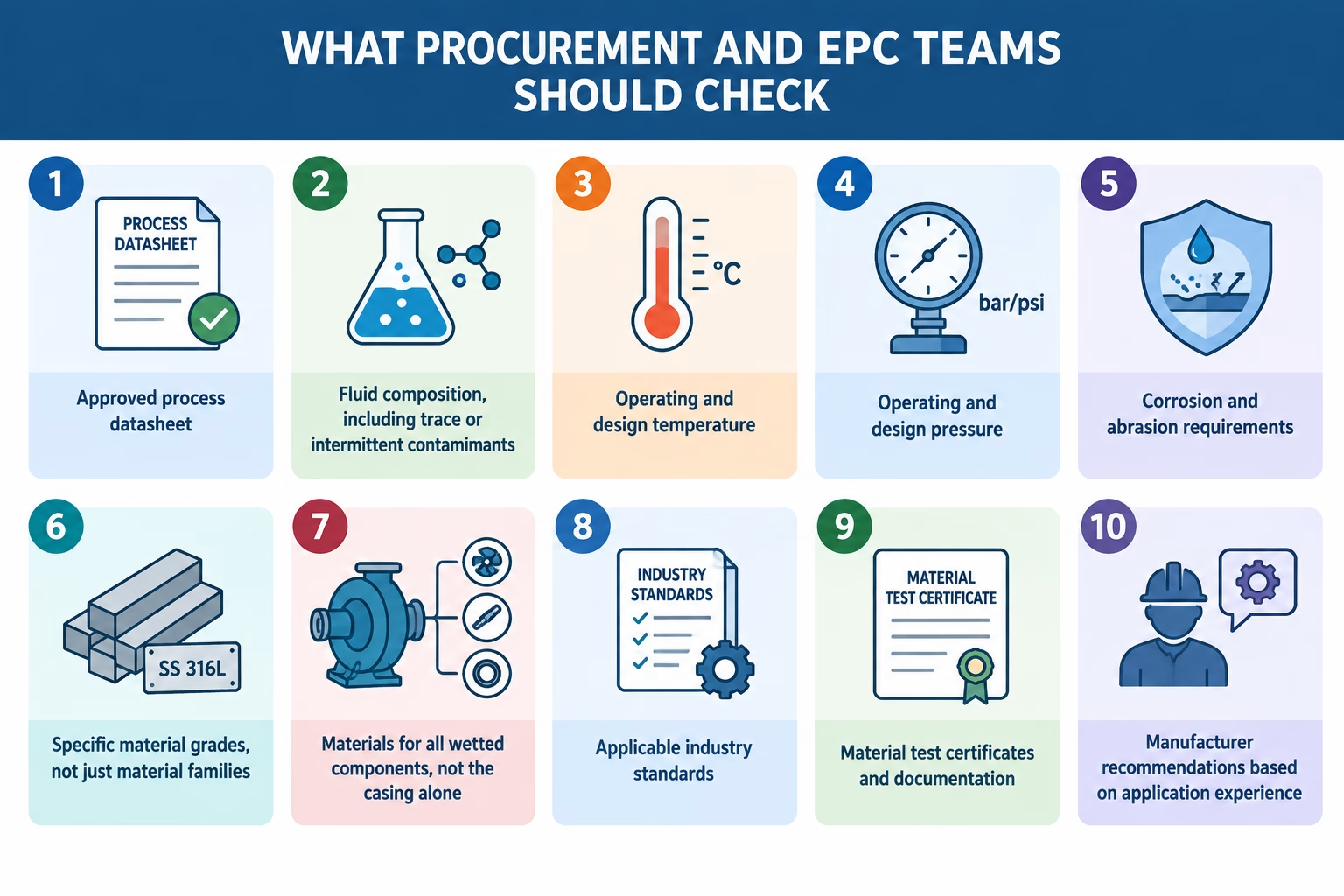
What Procurement and EPC Teams Should Check
Pump Casing Material Selection and Total Cost of Ownership
A lower-cost casing material that corrodes or wears prematurely in service can generate far higher costs over the pump’s lifecycle than a more expensive, correctly matched material — through more frequent component replacement, higher maintenance labor, and more unplanned downtime. As with pump selection generally, the lowest initial cost is not the same thing as the lowest lifecycle cost, and casing material decisions should be evaluated on that basis rather than purchase price alone.
SAM Turbo’s Engineering Approach to Pump Material Selection
SAM Turbo Industry Pvt. Ltd. brings more than 55 years of Centrifugal Pump Engineering and Manufacturing experience to industrial pumping applications across chemical, power, mining, steel, pulp & paper, sugar, water & wastewater and oil & gas sectors. Its application-focused approach considers the pumped fluid and full operating conditions — not just a generic material default — when recommending a casing material and construction for a given duty. Explore SAM Turbo’s Pump Selection resources for guidance on matching pump construction to your application.
Educational Example
Consider a clearly Hypothetical Industrial Scenario: A Plant requires a pump to transfer a moderately corrosive process fluid containing chlorides at an elevated temperature. The engineering team documents the fluid characteristics, evaluates the operating conditions against candidate materials, compares cast steel and duplex stainless steel options against the specific chloride and temperature profile, selects duplex stainless steel based on its chloride resistance being genuinely required for this duty, and documents the selection rationale for the project file. This example is illustrative only and does not represent an actual SAM Turbo customer or project.
How to Choose the Right Pump Casing Material
Frequently Asked Questions
What is pump casing material selection?
What are the most common pump casing materials?
What is the difference between cast iron and cast steel pump casings?
When should duplex stainless steel pumps be used?
Why does fluid chemistry matter for pump material selection?
Is stainless steel always suitable for chemical applications?
How does abrasion affect pump casing material choice?
What materials are used for slurry pump casings?
What are wetted pump components?
How does material selection affect pump lifecycle cost?
Conclusion
Effective Pump Casing Material Selection requires a balanced evaluation of several engineering and operational factors rather than relying on a single material property. Fluid characteristics, chemical compatibility, corrosion, abrasion, operating pressure, temperature, mechanical strength and lifecycle requirements all play an important role in determining the most suitable material. Cast iron, cast steel and duplex stainless steel each offer distinct advantages and limitations, making application-specific evaluation essential for achieving reliable and long-term pump operation.
There is no universal material that can meet the requirements of every industrial pumping application. A material suitable for general water service, for example, may not perform effectively in a corrosive Chemical Environment or an Abrasive Slurry application. With 55+ years of experience in industrial centrifugal pump engineering and manufacturing, SAM Turbo brings an application-focused approach to understanding diverse pumping requirements across industries such as Chemical, Mining, Steel, Power, Pulp & Paper, Sugar, Water & Wastewater and Oil & Gas. Careful material selection, supported by proper engineering evaluation, remains an important foundation for improving pump reliability, reducing maintenance challenges and supporting efficient long-term operation.
Need help selecting the right pump casing material for your application?
Connect with SAM Turbo’s engineering team to discuss your fluid characteristics and operating requirements.


