

INTRODUCTION
Industrial Pump Material Selection plays a critical role in determining pump wear resistance, maintenance costs, operational reliability and overall service life. Two pumps can have identical hydraulic designs, the same drive and installation conditions, yet perform very differently after a year of operation. One may continue running reliably until its planned overhaul, while the other may experience impeller pitting, shaft sleeve scoring and repeated wet-end component replacements. In many cases, the difference comes down to the materials used in pump construction.
This guide explains how pump materials influence wear resistance, maintenance requirements and long-term performance. It covers material requirements for major pump components, compares commonly used industrial pump materials, and examines how abrasion, corrosion, erosion and operating temperature affect material selection. It also explores how to make application-specific material choices for improved pump reliability and lower lifecycle costs.
Quick answer: Choose pump materials by working backwards from the duty: identify what is attacking the metal (abrasion, corrosion, erosion, temperature), match each component to that threat, and judge the result by lifetime cost, not purchase price. A harder or more corrosion-resistant material usually costs more up front but cuts wet-end changes, downtime and efficiency loss.
Why Material Selection Matters
A Pump converts power into flow, and the parts that touch the liquid pay the price. Wear removes metal from impeller vanes and casing walls, which opens clearances and lowers head and efficiency. Corrosion thins and pits surfaces and can start cracks. Erosion, often helped by cavitation or high velocity, strips protective films and attacks the metal underneath. Each of these shows up on a maintenance budget, on a downtime report and, eventually, on the plant’s output.
Material choice is also one of the few decisions that is expensive to reverse. Hydraulics can often be corrected with a new impeller trim or a speed change. A wrong casing material means a new casing. That is why it deserves attention at specification stage rather than after the first failure.
The Four Threats: Abrasion, Corrosion, Erosion and Temperature
The three wear mechanisms rarely act alone. The overlap diagram below shows how they combine, and why the worst failures sit where they meet.
Abrasion
Abrasion is cutting or gouging by hard particles. It depends on particle hardness, size, shape and velocity, so sharp, coarse, fast-moving solids do the most damage. The defence is hardness: materials such as high chrome iron and Ni-Hard are chosen because they resist cutting. Their trade-off is lower toughness, so heavy impact needs care.
Corrosion
Corrosion is chemical attack, driven by pH, chloride level, oxidising agents, temperature and the presence of dissolved gases. The defence is chemistry: chromium, nickel and molybdenum in stainless steels build a protective film, and duplex grades add resistance to chloride cracking. A useful comparison index for pitting resistance is:
PREN = %Cr + 3.3 × %Mo + 16 × %N
Higher PREN generally means better resistance to chloride pitting, which is why duplex and super-duplex grades rank above standard austenitic grades in chloride service. Typical values vary with the exact grade and should be taken from the supplier’s data.
Erosion and Cavitation
Erosion by high-velocity liquid removes protective films and exposes fresh metal, and cavitation collapse pits surfaces directly. Harder, tougher alloys such as stainless steel resist cavitation pitting better than plain cast iron, but the first line of defence is always sound suction conditions, covered in SAM Turbo’s NPSH calculation guide.
Temperature
Temperature speeds up corrosion, reduces strength, changes clearances through thermal expansion, and can lead to chloride stress corrosion cracking in some stainless steels. A material that is fine at ambient temperature can fail early in hot service, so the operating and upset temperatures both belong in the specification.
Material Requirements by Pump Component
Each part of the pump sees a different mix of threats, so the best material is rarely the same throughout.
Pump component and material requirement map.
Wear rings deserve particular attention. As clearances grow with wear, more liquid leaks back from discharge to suction, so flow and efficiency fall and the pump must work harder for the same output. Replaceable rings are a cheap way to restore performance, provided they are made from a material that wears in preference to the casing and impeller.
Fluid Compatibility: Matching Material to the Liquid
The liquid’s chemistry usually narrows the field first. Before any material is chosen, the specification should record the following, because each one can eliminate options:
- pH range, including cleaning and upset conditions, not just normal operation.
- Chloride content, which drives pitting and stress cracking in stainless steels.
- Solids content, size, hardness and shape, which set the abrasion level.
- Temperature range and any temperature excursions.
- Dissolved gases, oxidising agents or organic compounds that change corrosion behaviour.
For chemical duties SAM Turbo’s guide to chemical process pump materials for corrosive applications goes deeper on corrosion-resistant choices, so this article concentrates on the broader comparison and cost view.
Selection Funnel: From Duty to Material
The funnel below narrows the choice step by step. Starting with the liquid keeps the decision logical, and leaving cost until last stops price from driving the early choices.
1. Liquid chemistry
pH, chlorides, oxidisers
2. Solids and abrasion
size, hardness, concentration
3. Temperature and pressure
normal and upset
4. Component duty
casing, impeller, shaft, rings
5. Lifetime cost
purchase, maintenance, downtime, energy
Material choice
Material selection funnel — narrowing from the duty to the final choice.
How Materials Affect Maintenance Frequency and Operating Cost
The purchase price of a pump is only one part of what it costs. The chart below compares two illustrative options over five years on an abrasive duty: a standard material and a wear-resistant one. The numbers are an index, not real prices, but the shape is typical.
Standard material — total index 620
Wear-resistant material — total index 390
Purchase
Maintenance
Downtime
Energy loss
Five-year cost of ownership, standard vs wear-resistant material — illustrative index only.
Three effects explain the gap. Fewer wet-end changes cut labour, spares and the cost of the outage itself. Slower wear keeps clearances and impeller profile closer to design, so efficiency and head hold up. And planned replacement replaces emergency repair. The extra purchase cost is recovered quickly wherever wear is the main failure mode.
Engineer’s rule: If wear parts are being replaced more than once a year, the material (or the operating speed) is the first thing to review, not the replacement schedule.
Oversizing also feeds the problem, because a pump forced to run away from its best efficiency point wears faster; see SAM Turbo’s article on the effect of oversizing pumps.
Practical Applications by Industry
Mining & mineral processing
Abrasive tailings and ore slurry
Typical approach: High chrome or Ni-Hard wet ends
Steel plants
Scale, slag water, cooling water
Typical approach: Hard-wearing alloys for solids, cast iron or steel for clean water
Thermal power
Ash slurry, cooling water, boiler feed
Typical approach: Hard alloys for ash; steel or cast iron for water duty
Chemical processing
Acids, alkalis, solvents
Typical approach: Corrosion-resistant stainless or alloy grades
Pulp & paper
Fibrous stock, bleaching liquor
Typical approach: Graded cast iron or wear-resistant alloys, stainless for chemistry
Water & wastewater
Raw water, effluent, drainage
Typical approach: Cast iron and ductile iron, bronze or stainless where needed
SAM Turbo’s application guides for mining and mineral processing, steel plants and the slurry pump guide show how these choices play out in specific duties.
SAM Turbo Pumps and Verified Material Capabilities
SAM Turbo states that material selection for its pumps is based on abrasion, corrosion, solids content, temperature and operating conditions, and that pump type and materials should match the solids concentration, particle size and abrasiveness of the medium. The company profile describes a captive steel foundry with a capacity of 500 MT per month, a research wing that has developed a wear-resistant alloy called Samron-17 (rated at 500 BHN for pulp stock pumps), and a certified ISO 9001 quality system. SAM Turbo was established in 1971 in Coimbatore, Tamil Nadu, and its profile page gives further background: SAM Turbo company profile.
SAM Turbo pump series mapped to their stated wet-end materials.
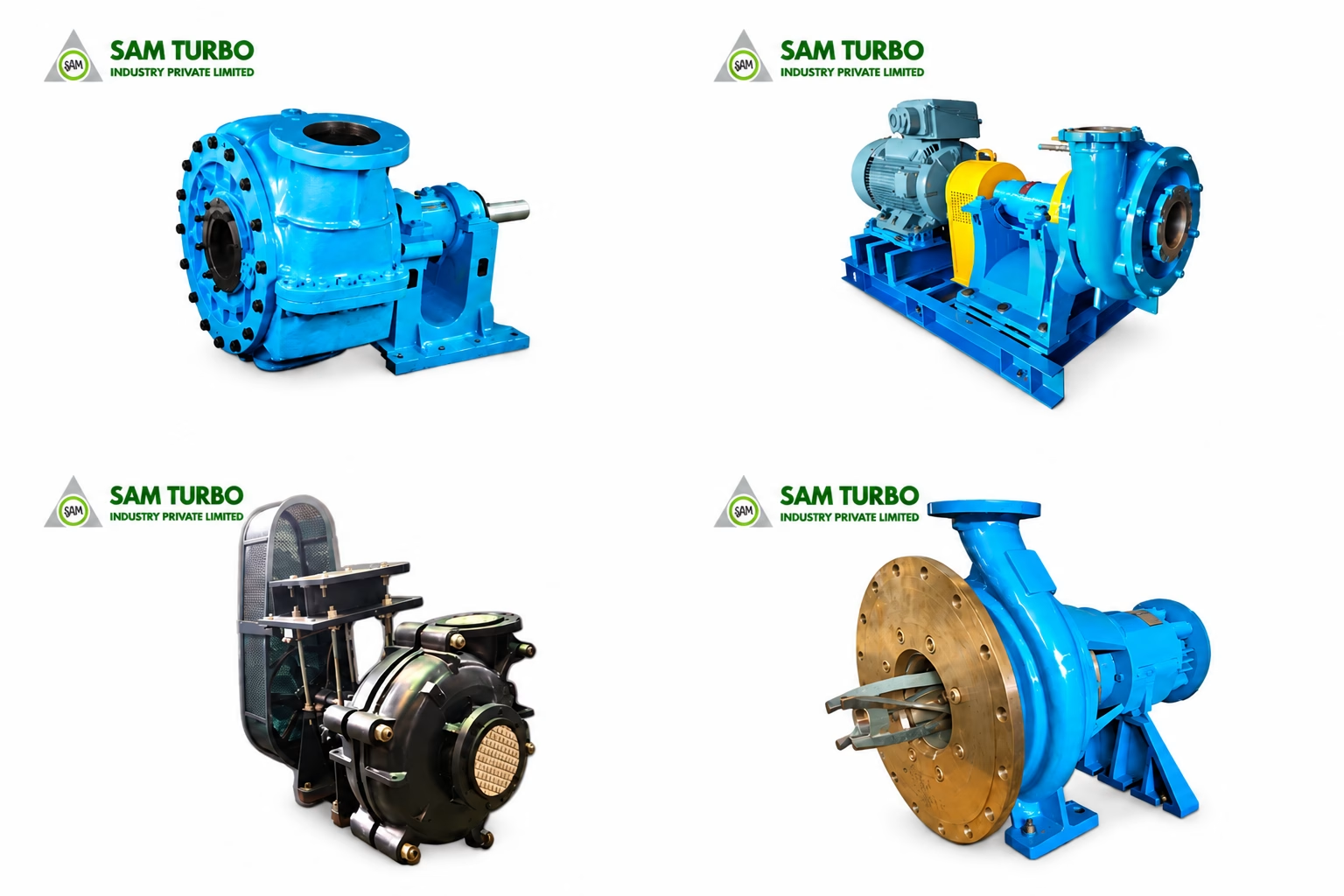
For abrasive slurry, SAM Turbo’s AR range pairs wear-resistant metallurgy with a double casing that protects the outer casing and lets the inner parts be replaced, which is how material selection and maintenance cost connect in practice. The Vertical Sump Pumps (VO) are offered with materials selected to suit the liquid, from clean and contaminated water to corrosive and abrasive liquids. For corrosive chemical duties, see the Chemical Process Pumps (CPC) and Process Pumps (TCH+N), and for pulp, the pulp and paper pump range.
SAM Turbo’s in-house manufacturing and machining, and hydraulic performance testing that verifies flow, head and operating requirements, back these ranges. The engineering team reviews the actual liquid, solids and temperature with the customer before the material is confirmed; the pump engineering blogand industrial pump range give more detail.
Common Material Selection Mistakes
- Choosing on purchase price alone and ignoring the cost of wear, downtime and lost efficiency.
- Specifying one material for every component instead of matching each to its own duty.
- Using stainless steel where abrasion, not corrosion, is the real threat.
- Forgetting upset conditions such as cleaning cycles, high chloride episodes or temperature excursions.
- Leaving solids size, hardness and concentration out of the data sheet.
Frequently Asked Questions
Why is pump material selection important?
It decides how quickly wetted parts wear, corrode or erode, which in turn sets maintenance frequency, downtime, efficiency loss and service life.
Which pump material is best for abrasive slurry?
High chrome iron and Ni-Hard are commonly used for abrasive slurry because of their hardness. The final choice depends on particle size, concentration, impact and chemistry.
When should I use stainless steel instead of cast iron?
When the liquid is corrosive, for example mildly acidic, saline or chemically aggressive, so that cast iron would corrode too quickly. Stainless is not ideal where hard abrasive solids are the main problem.
What is duplex stainless steel and why use it?
Duplex stainless has a mixed structure that gives high strength and good resistance to chloride pitting and stress cracking, so it suits chloride-bearing and seawater duties.
How does temperature affect pump material choice?
Higher temperature speeds corrosion, lowers strength, changes clearances and can cause stress cracking in some stainless grades, so operating and upset temperatures must be specified.
Which pump components need the hardest materials?
Impellers, casing liners and wear rings face the highest velocities and contact with solids, so they usually receive the hardest or most corrosion-resistant materials.
How do wear rings affect pump efficiency?
As wear rings wear, internal leakage from discharge to suction rises, lowering flow and efficiency. Replacing them restores clearances at low cost.
Does a more expensive material always save money?
Not always. It pays back when wear or corrosion is the main cause of maintenance. Where duty is mild, a standard material may be the better value.
What information should I give a manufacturer for material selection?
Provide liquid chemistry, pH, chlorides, temperature range, solids size, hardness and concentration, flow and head, and duty pattern, including upset conditions.
What materials do SAM Turbo AR slurry pumps use?
SAM Turbo’s AR Double Casing Slurry Pumps use high chrome or Ni-Hard wear-resistant metallurgy for wetted components, with custom material selection for abrasive, corrosive or chemically aggressive slurries.
Conclusion
Industrial pump material selection is a critical engineering decision that directly affects wear resistance, maintenance costs, operational reliability and overall pump service life. Choosing the right material requires evaluating the fluid properties, suspended solids, operating temperature, pressure and application conditions. A suitable material can minimize premature wear, reduce component replacement and improve long-term pumping performance.
At SAM Turbo Industry Pvt. Ltd., application-focused engineering, captive foundry capabilities and metallurgy control support reliable industrial pumping solutions. With over 55 years of manufacturing experience, SAM Turbo offers solutions such as the AR Double Casing Slurry Pump for demanding slurry-handling applications.
Ultimately, selecting the right pump material helps reduce unplanned downtime, control lifecycle costs and maintain consistent performance. Consult SAM Turbo’s engineering team to identify the right material and pump configuration for your industrial application.


