

Pump Performance Testing Standards are an essential part of Industrial Pump Evaluation, helping engineers determine whether a pump can achieve the expected operating performance under controlled test conditions. Before a pump is accepted for an industrial project, its hydraulic behaviour needs to be evaluated against the specified duty requirements. Understanding how performance tests are conducted, what parameters are measured, and how test results are interpreted gives EPC teams, consultants, and procurement professionals greater confidence when assessing pump equipment.
For SAM Turbo, Performance Verification is closely connected with the engineering and manufacturing of centrifugal pumps for demanding industries. With more than 55 years of experience, SAM Turbo works with a range of industrial pumping requirements where correct pump selection and dependable performance are important to plant operation. This article explores the standards, procedures, test methods, and practical considerations involved in industrial pump performance testing.
What Is Pump Performance Testing?
Pump Performance Testing is the controlled measurement of a pump’s actual Hydraulic and Mechanical Behavior — Flow, Head, Efficiency, Input power and Speed — under defined test conditions, compared against the values specified on the approved datasheet and performance curve. Rather than trusting catalog values alone, the pump is run on a test stand with calibrated instrumentation, and its measured performance is checked against agreed acceptance criteria before it’s released for shipment or accepted by the purchaser.
Why Pump Performance Testing Matters
Performance Testing serves several distinct purposes at once. It verifies that the pump genuinely meets the specified duty before it leaves the factory. It provides a documented quality assurance record tied to a specific serial number. On contracted projects, it forms part of the formal, contractual basis for accepting the equipment. And by catching a hydraulic mismatch or manufacturing deviation on the test bench rather than after installation, it meaningfully reduces commissioning risk — a discrepancy is far cheaper to correct in the factory than after a pump has been installed, piped and coupled on site.
Pump Performance Testing Standards
Three reference frameworks come up repeatedly in industrial pump testing, and they serve different purposes rather than being interchangeable. ISO 9906 is a hydraulic acceptance test standard that defines how flow, head, power and efficiency should be measured and what accuracy grades apply. Hydraulic Institute (HI) standards cover a broader set of North American testing and application guidance, including hydraulic performance testing and NPSH testing methodology. API 610 is a construction and design standard for centrifugal pumps in petroleum, heavy-duty chemical and gas industry service — it specifies mechanical design requirements and references acceptable test methods (including ISO 9906 or HI test procedures) rather than defining its own separate hydraulic test method from scratch. Treating these three as interchangeable is a common and costly specification mistake.
How the Three Standards Relate — Not Interchangeable, But Connected
API 610
Mechanical design & construction for hydrocarbon / critical service
→
references
ISO 9906 / HI 14.6
Hydraulic acceptance test method — flow, head, power, efficiency
→
produces
Signed Test Report
Basis for acceptance and handover documentation
ISO 9906 Explained
ISO 9906 covers rotodynamic pump hydraulic performance acceptance tests, defining grades of test accuracy (commonly referenced as Grade 1 and Grade 2, each with defined tolerance bands) that the purchaser and manufacturer agree to before testing. It specifies test conditions — such as the test fluid, permissible deviations from rated speed, and required instrument accuracy — along with how measurement uncertainty should be accounted for when comparing results to the guaranteed curve. Once testing is complete, the standard’s documentation requirements ensure the recorded flow, head, power and efficiency values, along with test conditions and instrumentation used, are captured in a formal test report that both parties can reference later.
Hydraulic Institute Standards & API 610
Hydraulic Institute standards (such as HI 14.6 for hydraulic performance testing) are widely used across North America and provide their own detailed test methodology, closely paralleling ISO 9906 in intent while differing in specific procedural detail. API 610, by contrast, is fundamentally a mechanical design and construction standard aimed at pumps in demanding, hazardous hydrocarbon service — it addresses things like baseplate rigidity, shaft deflection limits, bearing life and nozzle loading, and calls out acceptable hydraulic and NPSH test methods (including HI 14.6 or ISO 9906) rather than replacing them. In practice, a pump can be built to API 610’s mechanical requirements and still be hydraulically tested under ISO 9906 or HI procedures — the standards work together rather than competing. For a deeper comparison of how API 610 differs from ANSI/ISO 5199 in construction philosophy, see SAM Turbo’s guide to API 610 vs ANSI/ISO 5199 pump standards.
Parameters Measured During Pump Testing
| Parameter | What Is Measured | Why It Matters |
|---|---|---|
| Flow | Volumetric flow rate via calibrated flow meter | Confirms the pump delivers the required capacity |
| Head | Derived from suction and discharge pressure readings | Verifies the pump meets the specified duty point |
| Speed | Shaft rotational speed | Performance is speed-dependent and must be corrected if speed deviates |
| Power | Input power to the driver or measured shaft power | Used to calculate efficiency and confirm motor sizing |
| Efficiency | Calculated from flow, head and power | Confirms hydraulic performance and energy expectations |
| Suction/discharge pressure | Direct pressure gauge or transducer readings | Basis for calculating head across the test range |
| Temperature | Test fluid temperature | Affects fluid density and measurement accuracy |
| NPSH (where applicable) | Suction conditions at which performance degrades | Confirms cavitation margin for the intended installation |
How an Industrial Pump Performance Test Is Conducted
Pump Performance Test Workflow
→
→
→
→
→
→
→
The Process begins with reviewing the approved datasheet against the pump build. The test stand is then set up to the pump’s suction and discharge configuration, and instruments are checked and, where required, calibration certificates verified before testing begins. The pump is run across a range of flow points, data is recorded at each point, and the resulting curve is compared against the guaranteed performance curve and agreed tolerance. If the results fall within the accepted criteria, the test is signed off and a formal test report is issued.
What Is Witness Testing?
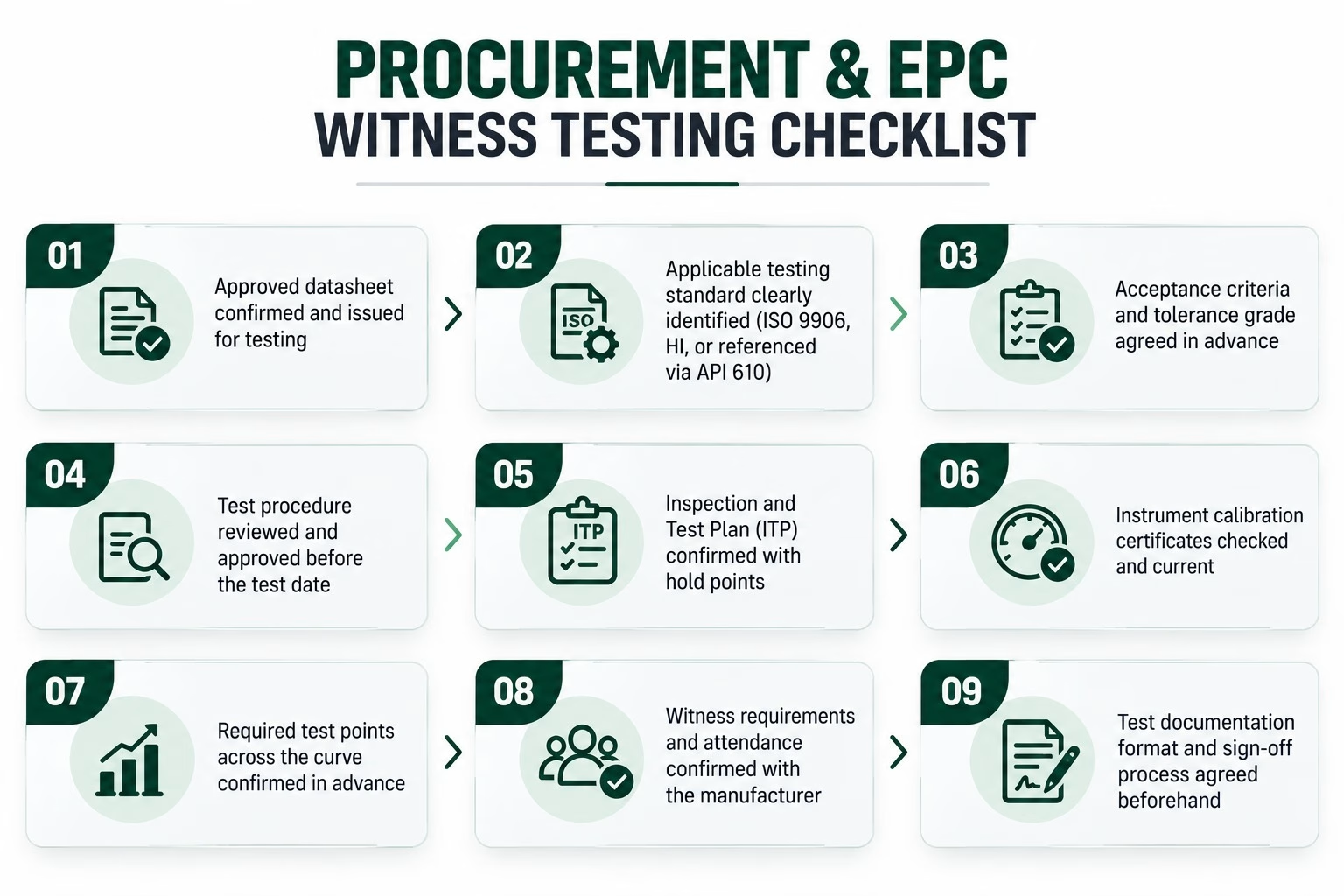
Witness Testing means the Purchaser, or a third-party inspection agency acting on the purchaser’s behalf, physically observes the performance test rather than relying solely on the manufacturer’s own test report. A typical witness test involves reviewing the test procedure in advance, checking that the test instrumentation and calibration are in order, observing the test itself, reviewing the recorded data against the agreed acceptance criteria, and formally signing the acceptance documentation on site. Witness testing adds an independent layer of verification, particularly valuable on high-value or critical-service pumps where the cost of a field failure would be significant.
Factory Acceptance Test vs Witness Test
| Aspect | Factory Acceptance Test (Unwitnessed) | Witness Test |
|---|---|---|
| Purpose | Confirm performance before shipment | Confirm performance with independent verification |
| Purchaser involvement | None; reviewed via submitted report | Purchaser or agent physically present |
| Testing performed | By manufacturer per approved procedure | By manufacturer, observed in real time |
| Documentation | Test report issued and submitted | Test report co-signed by the witness |
| Acceptance | Based on submitted documentation | Based on direct observation and sign-off |
Pump Performance Curve & BEP
A pump’s performance curve plots head, efficiency and power against flow across its operating range. The rated duty point is the specific flow and head the pump is purchased to deliver, while the Best Efficiency Point (BEP) is the flow at which the pump achieves its highest hydraulic efficiency. During acceptance testing, both the duty point and the shape of the curve near BEP are reviewed — a duty point that sits far from BEP can be a sign of a mismatched selection even if the guaranteed point itself is technically met.
NPSH Testing
NPSH Available (NPSHa) describes the suction energy available at the pump inlet from the actual installation, while NPSH Required (NPSHr) is a characteristic of the pump itself, determined by testing. When NPSHa falls too close to NPSHr, cavitation occurs — vapor bubbles form and collapse inside the pump, causing noise, vibration and accelerated wear. NPSH testing may be specifically required for critical, high-energy, or suction-sensitive applications where standard hydraulic testing alone doesn’t provide enough confidence in the suction margin. For a closer look at cavitation mechanisms, see SAM Turbo’s guide to NPSH in centrifugal pumps.
Test Instrumentation & Accuracy
Reliable results depend on properly calibrated instrumentation: flow meters appropriate to the test fluid and flow range, pressure instruments at suction and discharge, power measurement at the driver or shaft, speed measurement, and temperature monitoring of the test fluid. Each instrument carries its own calibration certificate and traceable accuracy class, and the combined measurement uncertainty across all instruments — not just the accuracy of any single gauge — determines how confidently a test result can be compared against the guaranteed curve.
Common Reasons for Performance Test Deviations
When a test result deviates from the guaranteed curve, the cause isn’t always the pump’s hydraulic design. Common contributing factors include an incorrect pump selection for the actual system conditions, running the pump off its rated speed, manufacturing variation in impeller trim or casting tolerances, an improperly configured test setup (piping arrangement, suction conditions), instrumentation error or drift, and test fluid or ambient conditions that differ from the assumptions in the guarantee. A systematic review of each of these areas, rather than assuming a single cause, gives a more reliable diagnosis.
Procurement & EPC Witness Testing Checklist
SAM Turbo’s Engineering & Quality Approach
SAM Turbo Industry Pvt. Ltd. brings more than 55 years of centrifugal pump engineering and manufacturing experience to industrial pumping applications. SAM Turbo is an ISO 9001:2015 and ISO 45001:2018 Certified company, and its application-focused approach to pump selection and manufacturing supports sectors including Power, Chemical, Mining, Steel, Pulp & Paper, Sugar, Water & Wastewater and Oil & Gas. Whether a project calls for standard hydraulic acceptance testing or a witnessed test to a specific procedure, understanding the applicable standard and acceptance criteria upfront helps both manufacturer and purchaser align expectations before testing begins.
Educational Example
Consider a Clearly Hypothetical EPC Scenario: A Project requires a Centrifugal Pump for a continuous-duty Chemical Transfer Application. The EPC team specifies the requirement on the datasheet, agrees ISO 9906 Grade 2 as the applicable testing standard, reviews and approves the manufacturer’s test procedure, attends the test as a witness, records the performance data at each test point, compares the results against the guaranteed curve and agreed tolerance, formally accepts the pump on meeting the criteria, and receives the signed test report and documentation for the project file. This example is illustrative only — it does not represent an actual SAM Turbo customer, project or test result.
How to Prepare for a Pump Witness Test
Ten steps up to Witness Test Day.
Confirm standard & tolerance grade
Approve the test procedure
Confirm ITP & hold points
Request calibration certificates
Confirm required test points
Clarify travel & attendance
Bring datasheet & curve
Agree deviation handling
Confirm report format
Retain documentation
— Test Day Ready
Frequently Asked Questions
What is Pump Performance Testing?
What are Pump Testing Standards?
What is ISO 9906?
What is Witness Testing?
What is the Difference Between a Factory Test and a Witness Test?
What Parameters are Measured during Pump Testing?
How is Pump Efficiency Verified during Testing?
What is API 610 and how does it relate to pump testing?
What is NPSH Testing?
What should EPC teams check for Pump Testing Requirements?
Conclusion
Pump Performance Testing standards give industrial project teams a practical framework for assessing whether a pump performs as expected and whether the supplied equipment aligns with the agreed technical requirements. Beyond simply checking test values, engineers should consider the complete test documentation, instrumentation, operating conditions, acceptance criteria, and applicable project specifications. A well-planned performance test can therefore become an important part of the overall equipment quality and acceptance process.
For SAM Turbo, Reliable Pump performance begins with understanding the application, Duty Conditions, and System requirements before the pump reaches the testing stage. Its experience in centrifugal pump engineering enables the company to develop pumping solutions for applications across power, chemical, mining, steel, cement, water, and other industries. Selecting a manufacturer with strong application knowledge and a systematic approach to performance evaluation can help project teams achieve greater confidence in their pumping systems.
RELATED BLOG CONTENT
Have questions about Pump Testing Standards or Witness Testing for Your Project?
Connect with SAM Turbo’s Engineering Team to discuss your Pump Application and Testing Requirements.


